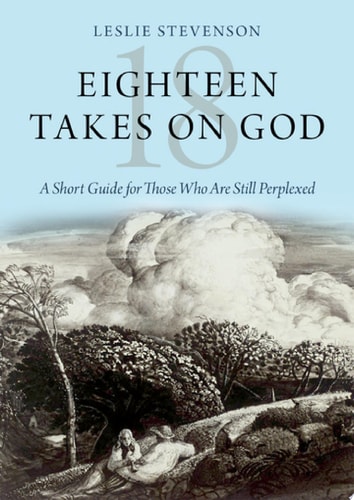
Eighteen Takes on God: A Short Guide for Those Who Are Still Perplexed
0
0
As an Amazon Associate and affiliate partner, Menrva Books earns from qualifying purchases. Learn more
Author Description
Who is God? How should we think about the concept of God? How have religions shaped and altered various conceptions of God over time? Many use language about God which, if taken at face value, implies that he inhabits a human body (usually male) and walks and talks as we do. Yet to other traditions God is a genderless and spiritual form unconstrained by space or time. And while some people are firm in their faith in God, however conceived, many others are uncertain what they think--what they believe, what they think they know, and how much they think one can know rather than believe. Even among believers, there are many conceptions of God from different points in time and parts of the world--even within faiths.For readers who are puzzled by religion, it helps to have an entry point into this confusing range of possibilities. In this short and friendly guide, Leslie Stevenson walks the reader through eighteen conceptions of God, tracing how women and men have perceived him (or her) since the time of Abraham.As Stevenson acknowledges, there can be no such thing as a completely detached and neutral approach to this subject. Everyone has their own upbringing, life experiences, prejudices, and commitments to (or rejections of) the religious traditions they have encountered. Moreover, there are anciently-entrenched differences in different strands of Hinduism and Buddhism, as there are between and within Jewish, Christian, and Islamic monotheistic conceptions of God. By ranging over the thought of philosophers of religion like Feuerbach, Kant, Wittgenstein, Iris Murdoch, Simone Weil, Rudolf Otto, Martin Buber, and Abbe Louf, and practice of the Quakers, Stevenson unpacks difficult questions, including whether religious language refers to anything beyond human life, and whether God is a person (or an existing being of any sort), whether he changes over time, or can be spoken of at all.Drawing from his deep familiarity with religion and philosophy acquired over decades of study.
Menrva's Summary
THE THESIS
This book investigates the diverse and often contradictory ways humanity has conceptualized the divine throughout history. Leslie Stevenson, drawing on decades of academic engagement with philosophy and religious studies, provides a structured framework to navigate the complex landscape of theological thought. By examining eighteen distinct perspectives, the author addresses the fundamental tension between human language, belief, and the nature of an ultimate reality.
THE SCOPE MAP
What You Will Find
- A comparative analysis of eighteen distinct conceptions of God across major religious traditions.
- Philosophical insights from thinkers including Feuerbach, Kant, Wittgenstein, Iris Murdoch, and Martin Buber.
- An examination of the linguistic and conceptual challenges inherent in discussing the divine.
Scope Limits
- The text does not provide a definitive theological argument or a singular conclusion regarding the existence of God.
- It does not offer an exhaustive history of every global religious practice, focusing instead on specific philosophical interpretations.
THE AUTHORITY PERSPECTIVE
Readers frequently note the accessible and concise nature of the prose, which distills complex philosophical debates into manageable segments. Experts highlight this as a helpful entry point for those seeking to understand the intellectual history of religious thought without becoming overwhelmed by academic jargon.
Page Count:
208
Publication Date:
2019-11-01
Publisher:
Oxford University Press
ISBN-10:
0190066105
ISBN-13:
9780190066109
Non-Fiction
Religion
History
Philosophy
World
Atheism
God
Theology
Agnosticism
Church Leadership
Religious
American Religions
Church History
Community Tags
Other Editions(2)
Similar Books




Reader Comments
Share Your Thoughts
No comments yet. Be the first to share your thoughts!