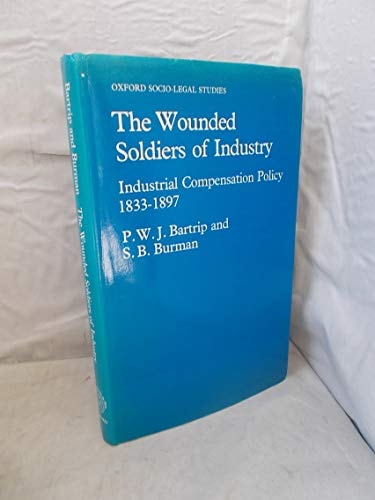
The Wounded Soldiers of Industry: Industrial Compensation Policy, 1833-1897
0
0
As an Amazon Associate and affiliate partner, Menrva Books earns from qualifying purchases. Learn more
Author Description
This book traces the process whereby Britain moved from being a society without industrial safety legislation to one in which a multitude of laws sought to protect the worker at the workplace. Ranging from the beginning of the reform movement to the passing of the Workmen's Compensation Act, the authors look at the legal and financial position of workers in the 1830s and before; the 19th-century statistics on work injury in mines, railways, and factories; and the significance of the new industrial law.
Menrva's Summary
THE THESIS
This book investigates the historical evolution of British industrial safety legislation and the transition toward formal compensation policies for injured workers between 1833 and 1897. Authors P. W. J. Bartrip and Sandra B. Burman utilize a socio-legal framework to examine how the British state shifted from a laissez-faire approach to one characterized by extensive regulatory oversight. By analyzing the intersection of legal reform, economic pressure, and humanitarian concern, the authors argue that the development of industrial law was a reactive process driven by the mounting human cost of the Industrial Revolution. Their research synthesizes legislative history with the social realities of the Victorian workforce.
THE SCOPE MAP
What You Will Find
- Analysis of the legal and financial status of laborers prior to the 1830s.
- Statistical examination of injury rates in the mining, railway, and factory sectors.
- Evaluation of the legislative progression leading to the Workmen's Compensation Act of 1897.
- Discussion of the socio-political dynamics between employers, the state, and the labor force.
THE AUTHORITY PERSPECTIVE
Experts recognize this work as a foundational text for understanding the origins of modern labor law and industrial safety standards in Britain. Readers frequently note the academic density of the prose and the meticulous use of primary historical records to support the authors' arguments.
Page Count:
260
Publication Date:
1984-01-01
Publisher:
Oxford University Press
ISBN-10:
0198275099
ISBN-13:
9780198275091
History
Industries history
British History
Labor Studies
Industrial history
Law
Community Tags
Similar Books