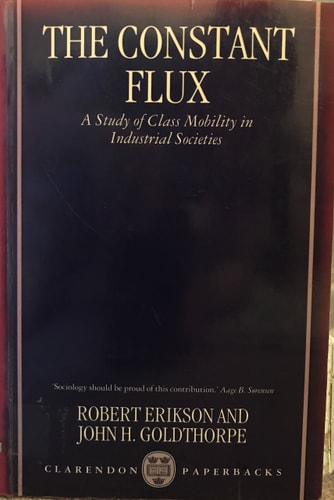
The Constant Flux: A Study of Class Mobility in Industrial Societies
0
0
As an Amazon Associate and affiliate partner, Menrva Books earns from qualifying purchases. Learn more
Author Description
This study of social mobility within the developing class structures of modern industrial societies is based on a unique data-set constructed by the authors. It focuses on the Western and Eastern European experience of social and economic growth after the Second World War, but also examines the experiences of the United States, Australia, and Japan. In combining historical and statistical analyses both of trends in mobility and of cross-national similarities and differences, the authors show that wide variation at the level of observed mobility coexists with a surprising degree of constancy and commonality in underlying patterns of social fluidity.
Menrva's Summary
THE THESIS
This work investigates whether the observed variations in social mobility across industrial nations mask a deeper, underlying constancy in social fluidity. The authors, John H. Goldthorpe and Robert S. Erikson, utilize a comprehensive, cross-national dataset to analyze the impact of post-World War II economic growth on class structures. By synthesizing historical context with rigorous statistical modeling, they argue that while surface-level mobility rates differ significantly between countries, the fundamental mechanisms governing social movement remain remarkably stable across diverse industrial societies.
THE SCOPE MAP
What You Will Find
- Comparative analysis of class mobility across Western Europe, Eastern Europe, the United States, Australia, and Japan.
- Statistical methodology for measuring social fluidity and class structure evolution.
- Longitudinal data examining the post-World War II era of economic expansion.
- Theoretical framework for distinguishing between observed mobility rates and underlying social fluidity.
THE AUTHORITY PERSPECTIVE
Sociologists and political scientists frequently cite this text as a foundational reference for comparative social stratification research. Experts note the high density of the statistical analysis, which provides a rigorous empirical basis for understanding long-term trends in industrial class systems.
Page Count:
445
Publication Date:
1993-01-01
Publisher:
Clarendon Press
ISBN-10:
0198279086
ISBN-13:
9780198279082
History
Economics
Sociology
Social Classes
Europe
Social Science
Community Tags
Similar Books