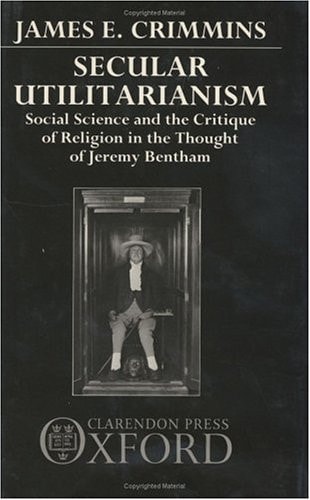
Secular Utilitarianism: Social Science and the Critique of Religion in the Thought of Jeremy Bentham
0
0
As an Amazon Associate and affiliate partner, Menrva Books earns from qualifying purchases. Learn more
Author Description
Jeremy Bentham was an ardent secularist convinced that society could be sustained without the support of religious institutions or beliefs. This book illustrates the nature, extent, and depth of Bentham's concern with religion, from his Oxford days of first doubts through the middle years of quiet unbelief to the zealous atheism and secularism of his later life. Crimmins provides an interpretation of Bentham's thought in which his religious views are shown to be integral: on the one hand, intimately associated with the metaphysical, epistemological, and psychological principles which gave shape to his system as a whole, and, on the other, central to the development of his entirely secular view of society.
Menrva's Summary
THE THESIS
This work investigates the foundational role of secularism within Jeremy Bentham's utilitarian philosophy and his systematic critique of religious institutions. James E. Crimmins, a scholar of political thought, utilizes Bentham's personal correspondence, early writings, and later philosophical treatises to argue that Bentham's atheism was not a peripheral interest but a core component of his social and psychological framework. The text demonstrates how Bentham's rejection of religious authority was inextricably linked to his broader epistemological and metaphysical commitments.
THE SCOPE MAP
What You Will Find
- A chronological analysis of Bentham's intellectual development from his early doubts at Oxford to his later radical secularism.
- An examination of the intersection between Bentham's psychological principles and his critique of religious dogma.
- A synthesis of primary source materials, including private papers and published philosophical works.
- An exploration of how Bentham proposed a social structure independent of religious institutions.
THE AUTHORITY PERSPECTIVE
Scholars recognize this text as a definitive study on the religious dimensions of Bentham's thought, often citing it for its meticulous archival research. It is frequently utilized by historians of political philosophy to understand the transition toward secular social science in the nineteenth century.
Page Count:
360
Publication Date:
1990-08-09
Publisher:
Clarendon Press
ISBN-10:
0198277415
ISBN-13:
9780198277415
History
Biography
Religion
Philosophy
Great Britain
Community Tags
Similar Books