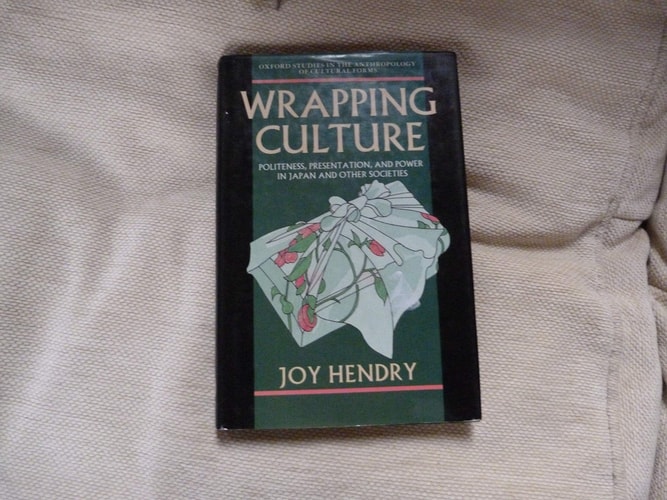
Wrapping Culture: Politeness, Presentation, and Power in Japan and Other Societies
0
0
As an Amazon Associate and affiliate partner, Menrva Books earns from qualifying purchases. Learn more
Author Description
Wrapping Culture examines problems of intercultural communication and the possibilities for misinterpretation of the familiar in an unfamiliar context. Starting with an examination of Japanese gift-wrapping, Joy Hendry demonstrates how our expectations are often influenced by cultural factors which may blind us to an appreciation of underlying intent. She extends this approach to the study of polite language as the wrapping of thoughts and intentions, garments as body wrappings, constructions and gardens as wrapping of space. Hendry shows how this extends even to the ways in which people may be wrapped in seating arrangements, or meetings and drinking customs may be constrained by temporal versions of wrapping. Throughout the book, Hendry considers ways in which groups of people use such symbolic forms to impress and manipulate one another, and points out a Western tendency to underestimate such nonverbal communication, or reject it as mere decoration. She presents ideas that should be valid in any intercultural encounter and demonstrates that Japanese culture, so often thought of as a special case, can supply a model through which we can formulate general theories about human behavior.
Menrva's Summary
THE THESIS
This work investigates how the concept of 'wrapping' serves as a fundamental symbolic framework for understanding social interaction, politeness, and power dynamics across diverse cultures. Joy Hendry, an anthropologist specializing in Japanese society, utilizes ethnographic observation to argue that what is often dismissed as mere decoration in Western thought is actually a sophisticated system of nonverbal communication. By analyzing Japanese gift-wrapping as a primary model, she constructs a broader theory regarding how humans use physical and social boundaries to manage intent, status, and interpersonal relationships.
THE SCOPE MAP
What You Will Find
- Analysis of Japanese gift-wrapping traditions as a metaphor for social interaction
- Examination of polite language as a form of verbal 'wrapping' for thoughts
- Exploration of spatial and temporal constraints, including seating arrangements and meeting customs
- Comparative study of how different societies use symbolic forms to manipulate or impress others
THE AUTHORITY PERSPECTIVE
Scholars and anthropologists frequently cite this text as a foundational study for understanding the intersection of material culture and social etiquette. Readers often note that the prose is accessible yet theoretically rigorous, making it a standard reference for those interested in intercultural communication.
Page Count:
240
Publication Date:
1995-06-22
Publisher:
Clarendon Press
ISBN-10:
0198280289
ISBN-13:
9780198280286
Non-Fiction
Sociology
Japan
Anthropology
Communication