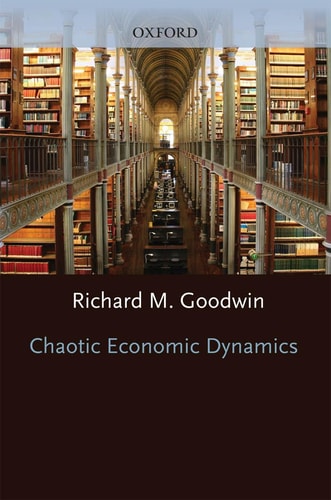
Chaotic Economic Dynamics
0
0
As an Amazon Associate and affiliate partner, Menrva Books earns from qualifying purchases. Learn more
Author Description
The new science of chaos came about through weather analysis. Starting from the premise that economics is equally unpredictable, this original new book explores the ways that chaos theory may be used for economic analysis. The author shows that, since chaos theory sets out to demonstrate erratic and unpredictable behavior in a situation of total cause and effect, it has much to offer in understanding human society and the unpredictable nature of economics. It has always been assumed that the highly irregular behavior of economic time series was the consequence of extra-economic disturbances such as political decisions, trade unions, the weather, foreign trade, etc. Goodwin makes it clear that there are not one, but two explanations of this confusing behavior.
Menrva's Summary
THE THESIS
This book investigates whether the erratic behavior observed in economic time series can be explained by internal chaotic dynamics rather than external disturbances. Richard M. Goodwin, a noted economist, applies the principles of chaos theory—originally developed in meteorology—to the field of economics. He argues that economic systems, despite being governed by cause and effect, can produce unpredictable outcomes that mimic random noise. The text provides a mathematical framework to demonstrate how deterministic models can account for the complex, irregular fluctuations typically attributed to exogenous shocks.
THE SCOPE MAP
What You Will Find
- Mathematical modeling of economic time series using non-linear dynamics.
- Comparative analysis between weather patterns and economic cycles.
- Theoretical arguments challenging the reliance on external variables like trade unions or political decisions.
- A synthesis of chaos theory applied to human societal behavior.
THE AUTHORITY PERSPECTIVE
Experts recognize this work as a significant contribution to the application of non-linear dynamics within economic modeling. Readers often note the technical density of the prose, which requires a foundational understanding of both economic theory and mathematical analysis.
Page Count:
152
Publication Date:
1990-01-01
Publisher:
Oxford University Press
ISBN-10:
0198283350
ISBN-13:
9780198283355
Economics
Non-Fiction
Economic Theory
Mathematics
Economics Mathematical
Chaos Theory
Community Tags
Similar Books