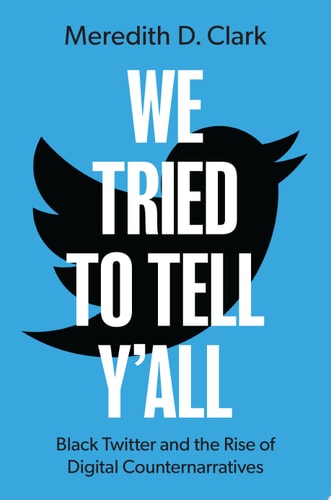
We Tried to Tell Y'All: Black Twitter and the Rise of Digital Counternarratives
0
0
As an Amazon Associate and affiliate partner, Menrva Books earns from qualifying purchases. Learn more
Author Description
Through interviews, news analysis, and personal observation, Meredith D. Clark presents the first book about how Black Twitter users carved out a vital space for fast-paced, incisive commentary on Black life in America not found in the mainstream press.Since 1827, when Freedom's Journal, the first newspaper to be published by free Black men in the United States, Black folks have been making use of the media technologies available to them to tell their own stories in their own ways. In We Tried to Tell Y'all: Black Twitter and the Rise of Digital Counternarratives, Meredith D. Clark explains how Black social media users subvert the digital divide narrative while confronting centuries of erasure, omission, and mischaracterization of Black life in 'mainstream' media.This ethnographic exploration of Black Twitter draws on news media analysis, in-depth interviews, and personal observation to trace the phenomenon's three levels of community connection, and advances a theory of Black Digital Resistance that illustrates how Black social media users harnessed the platform to annotate and narrate everything from play to protest to everyday life.From chapters that recognize the "locomotive power" of Black women and femmes' intellectual labor to a thorough takedown of so-called "cancel culture", We Tried to Tell Y'all offers readers a rich exploration of the latest chapter of Black media production. Regardless of the future direction of the platform, Black Twitter will forever remain an important moment in the long history of the Black press and Black social movements in the United States.
Menrva's Summary
THE THESIS
This book investigates how Black Twitter users have utilized digital platforms to construct counternarratives that challenge the historical erasure and misrepresentation of Black life in mainstream media. Meredith D. Clark, a scholar of digital media and Black studies, employs an ethnographic approach to analyze the evolution of Black digital spaces. By synthesizing news media analysis, in-depth interviews, and personal observation, she establishes the theory of Black Digital Resistance to explain how these users reclaim agency in the digital age.
THE SCOPE MAP
What You Will Find
- Historical context of Black media production from the 19th century to the present
- A three-level framework of community connection within Black Twitter
- Analysis of the intellectual labor performed by Black women and femmes
- Critical examination of the discourse surrounding cancel culture
Scope Limits
- The book focuses specifically on the United States context
- It does not provide a technical manual for platform usage or algorithm manipulation
THE AUTHORITY PERSPECTIVE
Scholars and media critics recognize this work as a foundational text for understanding the intersection of digital technology and racial justice movements. Readers frequently note the academic rigor of the research while appreciating the accessibility of the author's prose in documenting a significant shift in contemporary media history.
Page Count:
224
Publication Date:
2025-01-07
Publisher:
Oxford University Press
ISBN-10:
0190068140
ISBN-13:
9780190068141
Politics
Politics & Government
Technology and Society
Sociology
Communication Studies
United States
Digital Media
Black studies
Community Tags
Other Editions(3)
Similar Books


Reader Comments
Share Your Thoughts
No comments yet. Be the first to share your thoughts!