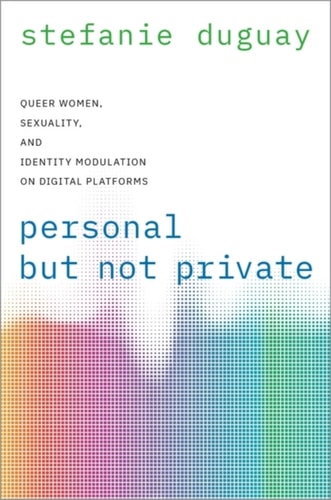
Personal but Not Private
0
0
As an Amazon Associate and affiliate partner, Menrva Books earns from qualifying purchases. Learn more
Author Description
Privacy has become a pressing concern for many users of digital platforms who fear legal or social liability for sharing personal details online. Yet for queer women and others, an emphasis on privacy fails to reflect the creativity and struggles of everyday people seeking to represent themselves and form meaningful connections through social media.Personal but Not Private explores how queer women share and maintain their identities through digital technologies despite overlapping technological, social, economic, and political concerns. Focusing on representations of sexual identity through Tinder, Instagram, and Vine, this volume uncovers how queer women are continuously engaging in identity modulation, or the process through which people and platforms adjust or modify personal information, to form relationships, increase their social and economic participation, and counter intersecting forms of oppression. While queer women's representations of sexual identity give rise to publics and counterpublics through intimate and collective self-representation, platform-specific elements like design and governance place limitations on queer women's agency and often make them targets of censorship, harassment, and discrimination. This book also considers how identity modulation can be applied to a range of people negotiating digital contexts and promotes tangible changes to digital platforms and their broader social, economic, and political structures to empower individuals and their personal sharing on social media.Bringing together personal interviews and empirical research, Personal but Not Private offers a new lens for examining digitally mediated identities and highlights how platforms act as complicated sites of transformation.
Menrva's Summary
THE THESIS
How do queer women navigate the tension between personal expression and digital privacy constraints on social media platforms? Stefanie Duguay, a scholar in communication and digital media, utilizes a framework of identity modulation to analyze how queer women negotiate their sexual identities online. By synthesizing empirical research with personal interviews, the author argues that users actively adapt their self-representation to circumvent platform-imposed limitations and systemic oppression.
THE SCOPE MAP
What You Will Find
- Analysis of identity modulation on Tinder, Instagram, and Vine
- Examination of platform design, governance, and algorithmic constraints
- Qualitative data derived from personal interviews with queer women
- Theoretical exploration of digital publics and counterpublics
Scope Limits
- The study focuses primarily on queer women and may not fully account for the experiences of other marginalized groups
- The research is limited to specific platforms and does not cover the entire landscape of contemporary social media
THE AUTHORITY PERSPECTIVE
Experts in digital sociology recognize this work as a significant contribution to the study of identity performance within constrained digital environments. Readers frequently note the academic rigor of the text, which provides a nuanced understanding of how platform architecture influences social behavior.
Page Count:
272
Publication Date:
2022-03-08
Publisher:
Oxford University Press Academic US
ISBN-10:
0190076208
ISBN-13:
9780190076207
General Health
Digital Media
Communications
Technology and Society
Queer Studies
Gender Studies
Social Aspects
Professional Career & Trade
Sexuality
Communication Studies
Sociology
Community Tags
Similar Books