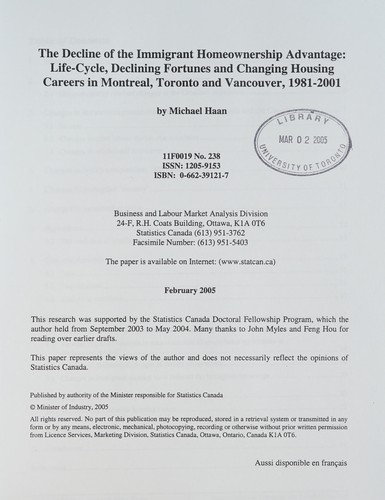
The Decline of the Immigrant Homeownership Advantage
0
0
As an Amazon Associate and affiliate partner, Menrva Books earns from qualifying purchases. Learn more
Author Description
In the past, working-age immigrant families in Canada's large urban centres had higher homeownership rates than the Canadian-born. Over the past twenty years however, this advantage has reversed, due jointly to a drop in immigrant rates and a rise in the popularity of homeownership among the Canadian-born. This paper assesses the efficacy of standard consumer choice models, which include indicators for age, income, education, family type, plus several immigrant characteristics, to explain these changes.
Menrva's Summary
THE THESIS
The decline of the immigrant homeownership advantage in Canada's large urban centers. This paper investigates the reversal of a long-standing trend where working-age immigrant families in Canada's major cities previously held higher homeownership rates than their Canadian-born counterparts. Over the last two decades, this advantage has diminished due to a decrease in immigrant homeownership and an increase among the Canadian-born population. The study employs standard consumer choice models, incorporating variables such as age, income, education, family type, and immigrant-specific characteristics, to analyze the factors contributing to this shift.
THE SCOPE MAP
- Analysis of immigrant homeownership rates in Canadian urban centers.
- Examination of trends in homeownership among the Canadian-born population.
- Assessment of standard consumer choice models to explain demographic shifts.
- Inclusion of variables: age, income, education, family type, and immigrant characteristics.
- Focus on changes observed over the past twenty years.
THE AUTHORITY PERSPECTIVE
This paper analyzes a significant demographic and economic shift in Canadian urban centers, focusing on the changing patterns of homeownership between immigrant and Canadian-born populations. The research utilizes established economic modeling techniques to dissect the contributing factors, suggesting a complex interplay of economic, social, and demographic variables. The findings are likely to be of interest to urban planners, sociologists, and economists studying immigration and housing markets.
Page Count:
28
Publication Date:
2005-01-01
ISBN-10:
0662391217
Economics
Non-Fiction
History
Sociology
Urban Studies
Community Tags
Similar Books














