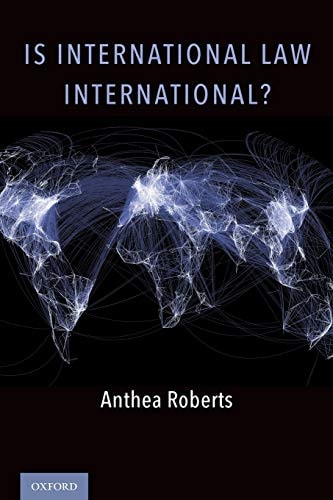
Is International Law International?
0
0
As an Amazon Associate and affiliate partner, Menrva Books earns from qualifying purchases. Learn more
Author Description
This book takes the reader on a sweeping tour of the international legal field to reveal some of the patterns of difference, dominance, and disruption that belie international law's claim to universality.Pulling back the curtain on the "divisible college of international lawyers," Anthea Roberts shows how international lawyers in different states, regions, and geopolitical groupings are often subject to distinct incoming influences and outgoing spheres of influence in ways that reflect and reinforce differences in how they understand and approach international law. These divisions manifest themselves in contemporary controversies, such as debates about Crimea and the South China Sea.Not all approaches to international law are created equal, however. Using case studies and visual representations, the author demonstrates how actors and materials from some states and groups have come to dominate certain transnational flows and forums in ways that make them disproportionately influential in constructing the "international." This point holds true for Western actors, materials, and approaches in general, and for Anglo-American (and sometimes French) ones in particular.However, these patterns are set for disruption. As the world moves past an era of Western dominance and toward greater multipolarity, it is imperative for international lawyers to understand the perspectives and approaches of those coming from diverse backgrounds. By taking readers on a comparative tour of different international law academies and textbooks, the author encourages them to see the world through the eyes of others -- an essential skill in this fast changing world of shifting power dynamics and rising nationalism.
Menrva's Summary
THE THESIS
Does international law actually function as a universal system, or is it a reflection of specific geopolitical power structures? Anthea Roberts, a professor of international law, investigates the "divisible college" of legal scholars and practitioners to challenge the assumption of a unified global legal framework. By analyzing the flow of legal materials, academic training, and professional influence, she argues that international law is heavily skewed toward Western and Anglo-American perspectives, which complicates its claim to true internationalism.
THE SCOPE MAP
What You Will Find
- Comparative analysis of international law textbooks and academic curricula across different regions.
- Visual mapping of transnational flows of legal actors and materials.
- Case studies on contemporary geopolitical flashpoints like the South China Sea and the annexation of Crimea.
- Examination of the dominance of Western and Anglo-American legal traditions in international forums.
Scope Limits
- The book does not provide a comprehensive history of every international legal institution.
- It does not offer a prescriptive manual for reforming international law, focusing instead on descriptive analysis of current power imbalances.
THE AUTHORITY PERSPECTIVE
Legal scholars and international relations experts frequently cite this work as a critical intervention in the sociology of international law. Readers often note the academic rigor of the prose and the effectiveness of the visual data in illustrating complex power dynamics.
Page Count:
434
Publication Date:
2019-04-15
Publisher:
Oxford University Press
ISBN-10:
0190066059
ISBN-13:
9780190066055
Law
New Used & Rental Textbooks
Legal Profession
Legal Education
Systems Theory
Comparative
International relations
Geopolitics
International Law
Sociology of Law
Community Tags
Other Editions(3)
Similar Books



Reader Comments
Share Your Thoughts
No comments yet. Be the first to share your thoughts!