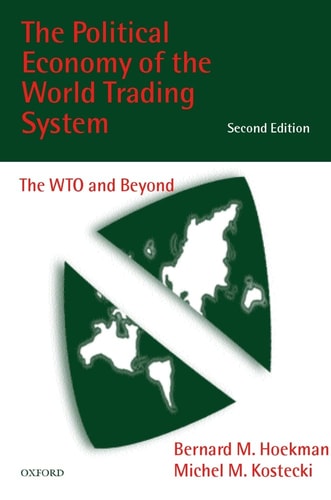
The Political Economy of the World Trading System: The WTO and Beyond
0
0
As an Amazon Associate and affiliate partner, Menrva Books earns from qualifying purchases. Learn more
Author Description
The creation of the World Trade Organization (WTO) in 1995 ushered in a new era in world trading arrangements. Building on the General Agreement on Trades and Tariffs (GATT), the intergovernmental treaty that for 50 years had regulated international trade relations, the WTO is a global organization of equal standing to the International Monetary Fund and the World Bank, and will set the agenda for international trade for decades to come. The authors of this volume were heavily involved in the Uruguay Round of GATT negotiations that laid the foundations for the creation of the WTO, and were ideally placed to see how the politics of negotiation affects the economics of trade.The Political Economy of the World Trading System is the first comprehensive and accessible introduction to the institutional mechanics, economics, and politics of the global trading networks. It goes beyond description of the rules of the WTO to analyse the political and economic forces that sculpted them, the incentives for countries to abide by them, and the likely future direction of the organization. The authors show how governments are not necessarily the social welfare-maximizing entities often found in textbooks, but instead develop policy subject to the pressures of a variety of interest groups. Although economic theory suggests that countries should pursue liberal trade policies and exchange goods and services on the basis of their comparative advantage, in practice most nations actively intervene in international trade. The political economy approach taken in this volume explains how the WTO functions, why GATT has been very successful in reducing tariffs, and why it has proven much more difficult to expand the reach of multilateral disciplines to domestic policies impacting on trade.This book will increase the reader's understanding of international economics, business, and international relations by supplying in-depth insider knowledge of how trade negotiations take place, how this de
Menrva's Summary
THE THESIS
This volume investigates the complex interplay between economic theory and political reality in the governance of the global trading system. Bernard M. Hoekman and Michel M. Kostecki, both seasoned participants in the Uruguay Round of GATT negotiations, utilize their insider expertise to examine how national governments formulate trade policy. They argue that trade agreements are not merely products of social welfare maximization but are instead shaped by the competing pressures of domestic interest groups and political incentives. By bridging the gap between abstract economic models and the practical mechanics of the World Trade Organization, the authors provide a framework for understanding why multilateral trade disciplines succeed or falter.
THE SCOPE MAP
What You Will Find
- Institutional analysis of the World Trade Organization and its predecessor, the General Agreement on Tariffs and Trade.
- A political economy framework explaining the divergence between theoretical liberal trade policies and actual government intervention.
- Examination of the influence of domestic interest groups on international trade negotiations.
- Assessment of the challenges involved in expanding multilateral rules to cover domestic policies.
THE AUTHORITY PERSPECTIVE
Experts and academics frequently cite this work as a foundational text for understanding the practical mechanics of international trade negotiations. Readers often note the balance between technical economic theory and the political realities that govern global trade policy.
Page Count:
576
Publication Date:
2001-09-27
Publisher:
Oxford University Press
ISBN-10:
0198294344
ISBN-13:
9780198294344
Economics
Trade Policy
Globalization
General Agreement on Tariffs and Trade Organization
International relations
Community Tags
Other Editions(2)
Similar Books





Reader Comments
Share Your Thoughts
No comments yet. Be the first to share your thoughts!