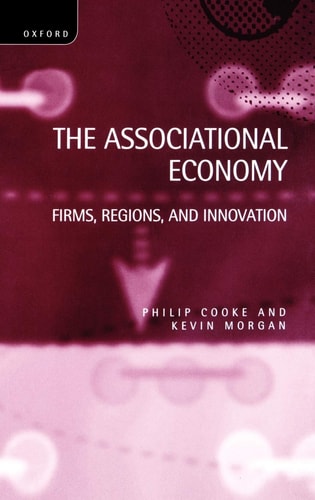
The Associational Economy: Firms, Regions, and Innovation
0
0
As an Amazon Associate and affiliate partner, Menrva Books earns from qualifying purchases. Learn more
Author Description
Cooke and Morgan explore important issues of corporate reorganization in the context of heightened global competition, focusing upon how firms associate with regional milieu. In-depth studies of inter-firm and firm-agency interactions are presented for four European regions: Baden-Wurttemberg and Emilia-Romagna as accomplished regional economies; Wales and the Basque Country as learning regions. The book is theoretically informed by an evolutionary economics perspective and draws policy conclusions which emphasize the importance of decentralized industrial policy in support of both corporate and regional economic development ambitions. It concludes that the associational economy may be the third way between state and market coordination of modern economies.
Menrva's Summary
THE THESIS
This book investigates whether the 'associational economy' serves as a viable third way between traditional state-led and market-driven coordination in modern industrial systems. Philip Cooke and Kevin Morgan, both established scholars in regional development and economic geography, utilize an evolutionary economics framework to analyze how corporate reorganization and regional milieu interact under the pressures of global competition. They argue that decentralized industrial policy is essential for fostering innovation and economic resilience in both established and emerging regional economies.
THE SCOPE MAP
What You Will Find
- Comparative analysis of four European regions: Baden-Wurttemberg, Emilia-Romagna, Wales, and the Basque Country.
- Theoretical framework grounded in evolutionary economics and regional innovation systems.
- Empirical studies of inter-firm and firm-agency interactions within specific regional clusters.
- Policy recommendations for decentralized industrial development and corporate-regional synergy.
THE AUTHORITY PERSPECTIVE
Experts in economic geography and regional planning frequently cite this work as a foundational text for understanding the 'learning region' concept. Readers often note the academic density of the prose, which is primarily intended for researchers, policymakers, and graduate students in the field of economic development.
Page Count:
264
Publication Date:
1998-06-11
Publisher:
Oxford University Press
ISBN-10:
0198290187
ISBN-13:
9780198290186
Economics
Business
Europe
Industrial Policy
Research Industrial
Innovation
Community Tags
Similar Books