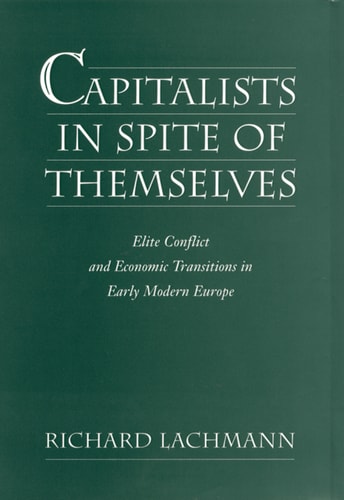
Capitalists in Spite of Themselves: Elite Conflict and European Transitions in Early Modern Europe
0
0
As an Amazon Associate and affiliate partner, Menrva Books earns from qualifying purchases. Learn more
Author Description
Here, Richard Lachmann offers a new answer to an old question: Why did capitalism develop in some parts of early modern Europe but not in others? Finding neither a single cause nor an essentialist unfolding of a state or capitalist system, Lachmann describes the highly contingent development of various polities and economies. He identifies, in particular, conflict among feudal elites--landlords, clerics, kings, and officeholders--as the dynamic which perpetuated manorial economies in some places while propelling elites elsewhere to transform the basis of their control over land and labor.Comparing regions and cities within and across England, France, Italy, Spain, and the Netherlands from the twelfth through eighteenth centuries, Lachmann breaks new ground by showing step by step how the new social relations and political institutions of early modern Europe developed. He demonstrates in detail how feudal elites were pushed toward capitalism as they sought to protect their privileges from rivals in the aftermath of the Reformation.Capitalists in Spite of Themselves is a compelling narrative of how elites and other classes made and responded to political and religious revolutions while gradually creating the nation-states and capitalist markets which still constrain our behavior and order our world. It will prove invaluable for anyone wishing to understanding the economic and social history of early modern Europe.Capitalists in Spite of Themselves was the winner of the 2003 Distinguished Scholarly Publication Award of the American Sociology Association.
Menrva's Summary
THE THESIS
Why did capitalism emerge in specific regions of early modern Europe while failing to take root in others? Richard Lachmann, a sociologist, challenges traditional theories that attribute the rise of capitalism to singular causes or inevitable systemic evolution. Instead, he argues that the development of capitalist markets was a highly contingent outcome of intense power struggles among competing feudal elites, including landlords, clerics, and state officials, who were forced to reorganize their control over labor and land to maintain their status following the Reformation.
THE SCOPE MAP
What You Will Find
- Comparative analysis of political and economic development across England, France, Italy, Spain, and the Netherlands.
- A historical timeline spanning the twelfth through the eighteenth centuries.
- Examination of elite conflict dynamics as a catalyst for institutional change.
- Theoretical framework linking religious and political revolutions to the formation of modern nation-states.
THE AUTHORITY PERSPECTIVE
Scholars and historians recognize this work as a significant contribution to historical sociology, frequently citing its rigorous comparative methodology. It is widely regarded as a foundational text for understanding the intersection of elite power dynamics and the structural origins of modern economic systems.
Page Count:
336
Publication Date:
2002-10-24
Publisher:
Oxford University Press
ISBN-10:
0195159608
ISBN-13:
9780195159608
Economics
History
Sociology
Europe