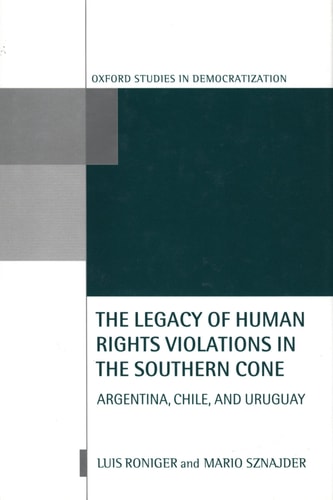
The Legacy of Human-Rights Violations in the Southern Cone: Argentina, Chile, and Uruguay
0
0
As an Amazon Associate and affiliate partner, Menrva Books earns from qualifying purchases. Learn more
Author Description
This book provides a systematic and comparative study of the way three countries in the Southern Cone of the Americas have confronted the legacy of past human rights violations. It examines their attempts to rebuild human rights through public accountability, compensation, educational policy, constitutional reform, and debates about national history and collective memory.
Menrva's Summary
THE THESIS
This book investigates how Argentina, Chile, and Uruguay have systematically addressed the enduring political and social legacies of past human rights violations during their transitions to democracy. Authors Mario Sznajder and Luis Roniger utilize a comparative framework to analyze the mechanisms of accountability, compensation, and institutional reform employed by these nations. By examining the intersection of public policy and collective memory, the authors evaluate the effectiveness of state-led efforts to reconcile with authoritarian pasts.
THE SCOPE MAP
What You Will Find
- Comparative analysis of transitional justice policies in Argentina, Chile, and Uruguay.
- Examination of institutional mechanisms including constitutional reform and educational policy.
- Assessment of the role of collective memory and public accountability in democratic consolidation.
- Evaluation of compensation programs and legal frameworks for addressing past state violence.
THE AUTHORITY PERSPECTIVE
Experts in Latin American politics recognize this work as a foundational comparative study for understanding the complexities of post-authoritarian reconciliation. Readers frequently note the academic density of the prose and the thoroughness of the cross-national analysis provided by the authors.
Page Count:
384
Publication Date:
1999-09-23
Publisher:
Oxford University Press
ISBN-10:
0198296150
ISBN-13:
9780198296157
History
Human rights
Community Tags
Similar Books