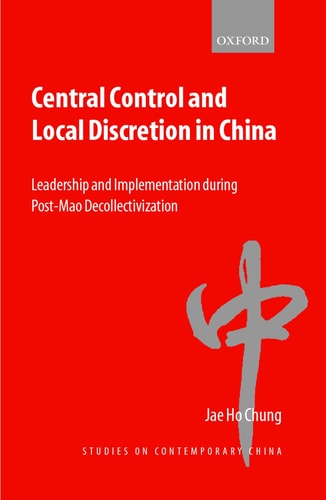
Central Control and Local Discretion in China: Leadership and Implementation during Post-Mao Decollectivization
0
0
As an Amazon Associate and affiliate partner, Menrva Books earns from qualifying purchases. Learn more
Author Description
This book analyzes the decollectivization reform in China during the early 1980s in order to gauge its impact on central control and provincial discretion. The volume challenges the notion that the decision to decentralize administrative authority ipso facto produces local discretion properly keyed to local conditions. In fact, outcomes often differ from the intended goals.
Menrva's Summary
THE THESIS
This book investigates the complex relationship between central administrative directives and local implementation outcomes during the Chinese decollectivization reforms of the early 1980s. Jae Ho Chung, a scholar specializing in Chinese politics and regional governance, utilizes empirical case studies to challenge the assumption that decentralization automatically empowers local authorities to act in accordance with specific regional conditions. The work argues that the transfer of authority often results in unintended consequences, where central control remains pervasive despite formal shifts in policy framework.
THE SCOPE MAP
What You Will Find
- Analysis of the decollectivization reform period in China during the early 1980s.
- Examination of the tension between central government mandates and provincial administrative discretion.
- Case studies detailing the implementation of agricultural and economic policies at the local level.
- Evaluation of the structural constraints that prevent local actors from effectively tailoring policies to regional needs.
THE AUTHORITY PERSPECTIVE
Experts in the field of contemporary Chinese studies recognize this volume as a rigorous examination of the limitations of decentralization in a centralized state. Readers frequently note the academic density of the prose, which provides a foundational understanding of the bureaucratic mechanisms governing post-Mao China.
Page Count:
226
Publication Date:
2000-10-26
Publisher:
Oxford University Press
ISBN-10:
0198297777
ISBN-13:
9780198297772
Economics
History
Privatization
China
Public Policy
Community Tags
Similar Books