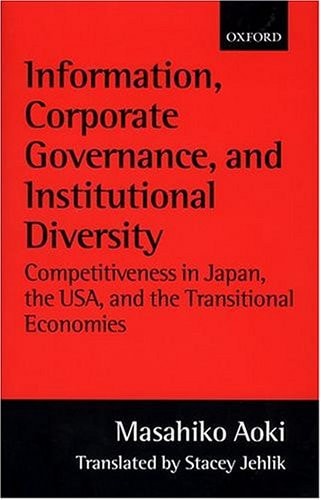
Information, Corporate Governance, and Institutional Diversity: Competitiveness in Japan, the USA, and the Transitional Economies
0
0
As an Amazon Associate and affiliate partner, Menrva Books earns from qualifying purchases. Learn more
Author Description
This book uses comparative institutional analysis to explain differences in national economic performance. Countries have their own rules for corporate governance and they have different market arrangements; and these differences in rules and organization affect the way firms behave. Countries also tend to develop conventions of organizational architecture of firmswhether their hierarchies are functional, horizontal, or decentralized. This affects the way in which they process information, and information management is increasingly seen as being of crucial importance to a firm's performance.
Menrva's Summary
THE THESIS
This book investigates how variations in national institutional frameworks and corporate governance structures dictate economic competitiveness and firm-level performance across different global markets. Masahiko Aoki, a prominent economist known for his work in comparative institutional analysis, utilizes a rigorous framework to examine how specific organizational architectures—ranging from functional hierarchies to decentralized systems—influence information processing. By contrasting the economic systems of Japan, the United States, and transitional economies, the author argues that national conventions of firm organization are not merely cultural artifacts but are strategic responses to information management requirements.
THE SCOPE MAP
What You Will Find
- Comparative analysis of corporate governance models in Japan, the USA, and transitional economies.
- Theoretical framework for organizational architecture, including functional, horizontal, and decentralized hierarchies.
- Examination of information processing as a primary driver of firm-level competitiveness.
- Analysis of how national institutional rules constrain and shape firm behavior.
THE AUTHORITY PERSPECTIVE
Experts recognize this work as a foundational text for understanding the intersection of institutional economics and corporate strategy. Readers frequently note the academic density of the prose, which is intended for scholars and professionals interested in the structural underpinnings of global economic performance.
Page Count:
200
Publication Date:
2001-03-08
Publisher:
Oxford University Press
ISBN-10:
0198297033
ISBN-13:
9780198297031
Business
Economics
Competition
Corporate governance
Community Tags
Similar Books