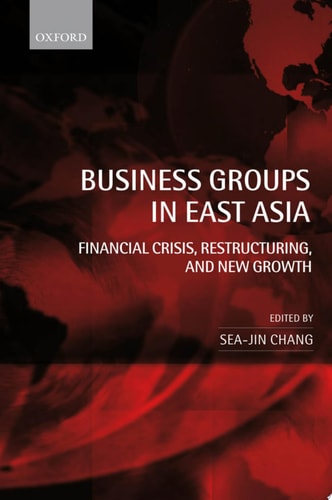
Business Groups in East Asia: Financial Crisis, Restructuring, and New Growth
0
0
As an Amazon Associate and affiliate partner, Menrva Books earns from qualifying purchases. Learn more
Author Description
The 1997 Asian Crisis principally affected Thailand, Indonesia, Malaysia, and Korea, as well as other East Asian countries heavily dependent on intra-regional trade. Banks and other financial institutions quickly become insolvent, and heavily indebted industrial firms went bankrupt. Many of these firms were affiliated with the business groups of this region, yet most groups did not immediately collapse, indeed they proved remarkably robust, some surviving and even prospering. This book examines these East Asian business groups and their subsequent restructuring following the Asian Crisis. East Asian nations embarked on very different trajectories to this common external shock. The Asian Crisis affected the inter-relationships among the socio-cultural environment, the state, and the market of each country quite differently and had distinct effects on the operations of these countries' business groups. This slow yet divergent pattern of development provides evidence against theories of rapid global convergence. Yet East Asian business groups face an uncertain future. Foreign investors' influence has increased substantially since the crisis, as East Asian governments had to accommodate their demands to keep attracting foreign capital. Governments supervise banks more closely and have loosened restrictions on mergers and hostile takeovers, further strengthening the discipline of the market. Various entry barriers that had inhibited foreign multinationals from competing in national markets were lifted, exposing business groups to intensified foreign competition. Under these new conditions, business groups in East Asia should reconfigure their business structures and adjust their corporate governance systems to regain momentum for further growth. Business groups will continue to be important vehicles for the sustained future growth of this region, and this book presents a substantial amount of new data on this, which will be of interest to academics, researchers, and adva
Menrva's Summary
THE THESIS
This book investigates how East Asian business groups navigated the 1997 financial crisis and adapted their corporate structures to survive and grow in a changing global market. Sea-Jin Chang, a professor specializing in international business and strategy, utilizes extensive empirical data to analyze the divergent paths taken by firms in Korea, Thailand, Malaysia, and Indonesia. The author argues that despite the external shock of the crisis, these business groups demonstrated significant resilience, though they were forced to reconfigure their governance systems to accommodate increased foreign investment and market discipline.
THE SCOPE MAP
What You Will Find
- Comparative analysis of business group restructuring in Korea, Thailand, Malaysia, and Indonesia.
- Data on the impact of foreign ownership and increased market competition on domestic firms.
- Examination of the shifting relationship between state policy, financial institutions, and industrial conglomerates.
Scope Limits
- The analysis focuses primarily on the period immediately following the 1997 crisis and does not cover long-term developments beyond the early 2000s.
- The text does not provide a comprehensive history of all East Asian economies, focusing specifically on those most affected by the 1997 financial collapse.
THE AUTHORITY PERSPECTIVE
Experts highlight this work as a foundational text for understanding the structural evolution of East Asian conglomerates in the wake of systemic financial failure. Readers frequently note the academic density of the prose and the extensive use of quantitative data to support the author's arguments regarding corporate governance.
Page Count:
288
Publication Date:
2006-01-01
Publisher:
Oxford University Press
ISBN-10:
0191536954
ISBN-13:
9780191536953
Business
Economics
Corporate governance
Finance
International business
Asian Studies
Community Tags
Similar Books