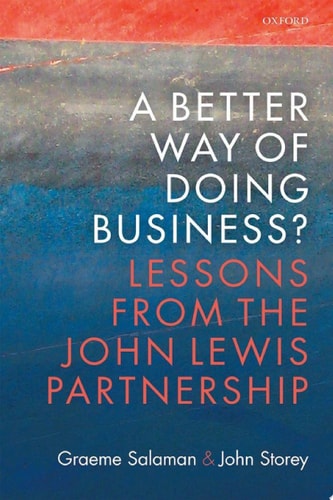
A Better Way of Doing Business?: Lessons from The John Lewis Partnership
0
0
As an Amazon Associate and affiliate partner, Menrva Books earns from qualifying purchases. Learn more
Author Description
This book offers a thoroughly researched and accessibly written account of the John Lewis Partnership. It describes what the JLP is, how it works, and what other businesses can learn from it. The US/UK model of the firm, with its emphasis on shareholder value and its openness to the market in the buying and selling of businesses, is prone to a number of problematic consequences for employees, suppliers, and sometimes share-holders. The JLP represents a contrast to this model - one that has implications beyond the small niche of mutually-owned firms. The JLP has lessons for organizations that are unlikely to move towards the Partnership's distinctive shared ownership. This book identifies these lessons. The key questions addressed include: how does the JLP work in practice? What is the link between co-ownership, the JLP employment model, and the performance of the businesses? What is the role of management in the success of John Lewis and Waitrose? Are mutuality, co-ownership and business performance at odds? What is the significance of democracy within the JLP? And probably most significantly: what are the implications, for policy-makers and for economic agents of the JLP? This book is based on detailed knowledge of the JLP and its constituent business gathered by the authors over a fifteen year period. Their conclusion: that the JLP is more complex, even more impressive, and more interesting than its admirers realise.
Menrva's Summary
THE THESIS
Can the unique structure of the John Lewis Partnership offer a viable, high-performance alternative to the traditional shareholder-value model of business? The authors, Graeme Salaman and John Storey, utilize fifteen years of empirical research and internal observation to analyze the mechanics of the John Lewis Partnership (JLP). They argue that the JLP’s commitment to co-ownership and democratic management provides a robust framework that challenges conventional assumptions about the necessity of market-driven, shareholder-centric corporate governance.
THE SCOPE MAP
What You Will Find
- Analysis of the JLP employment model and its impact on business performance.
- Examination of the role of management within a democratic, co-owned structure.
- Evaluation of the relationship between mutuality and commercial success in retail.
- Implications of the JLP model for broader economic policy and organizational design.
Scope Limits
- The text focuses primarily on the UK retail context and does not provide a comprehensive global survey of all cooperative models.
- It does not offer a step-by-step manual for converting traditional firms into partnerships.
THE AUTHORITY PERSPECTIVE
Experts and business scholars recognize this work as a definitive case study on the John Lewis Partnership, noting the depth of the authors' long-term access to the organization. Readers frequently highlight the academic rigor of the prose, which balances detailed organizational analysis with broader implications for contemporary economic policy.
Page Count:
249
Publication Date:
2016-01-01
Publisher:
OUP Oxford
ISBN-10:
019108560X
ISBN-13:
9780191085604
Economics
Business
Cooperative Business Models
Management
Corporate governance
Community Tags
Similar Books