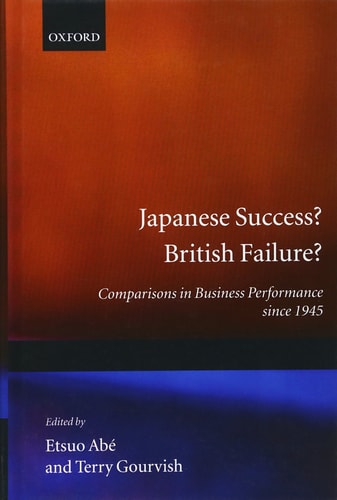
Japanese Success, British Failure: Comparisons in Business Performance Since 1945
0
0
As an Amazon Associate and affiliate partner, Menrva Books earns from qualifying purchases. Learn more
Author Description
The significance in business and economic history of Japan's startling rise in international competitiveness since the mid-1950s has not only given business academics much food for thought but has also served to increase the amount of English-language writing on modern Japan. Many researchers have sought to dissect the "economic miracle", isolating key factors which range from the national character and "consensus" to the favorable conjunction of market forces, from unique structural elements and government policy to a "free ride" based on American support and free trade.This new book uses a comparative perspective to highlight the many components of this miracle. By looking at the key facets of international competitiveness in Japan and Britain, new light is shed on the secrets of Japanese growth while refining allegations of British "failure." There are two main contributions (one by a Japanese and the other by a British scholar) on the following key variables: the government-industry relationship; management structures; education and training; and finance. The book goes on to feature several new case studies of automobiles and electronics. These essays revise many established notions concerning the two countries. Differences in education/business links, for example, are not as pronounced as is often claimed, and the performance gap in financial services is now much narrower. This book will serve as a useful starting point for further research on the critical aspects of modern corporate behavior and global competitiveness.
Menrva's Summary
THE THESIS
This work investigates the divergent economic trajectories of Japan and Britain since 1945 to identify the structural and policy-driven factors behind Japan's competitive rise and Britain's perceived industrial decline. The authors, Etsuo Abé and Terry Gourvish, utilize a comparative analytical framework to move beyond simplistic explanations of the Japanese economic miracle. By examining specific institutional variables, they challenge conventional narratives regarding the inevitability of British failure and the uniqueness of Japanese corporate success.
THE SCOPE MAP
What You Will Find
- Comparative analysis of government-industry relationships in Japan and Britain.
- Examination of management structures, education, and training systems.
- Detailed case studies focusing on the automobile and electronics industries.
- Evaluation of financial services and their role in national competitiveness.
THE AUTHORITY PERSPECTIVE
Experts recognize this text as a valuable contribution to comparative economic history that successfully nuances the debate surrounding post-war industrial performance. Scholars often cite the book for its balanced approach in challenging established myths about both the Japanese miracle and British decline.
Page Count:
304
Publication Date:
1998-02-12
Publisher:
Oxford University Press
ISBN-10:
0198290586
ISBN-13:
9780198290582
Economics
History
Business
Comparative Studies
Great Britain
International relations
Community Tags
Similar Books