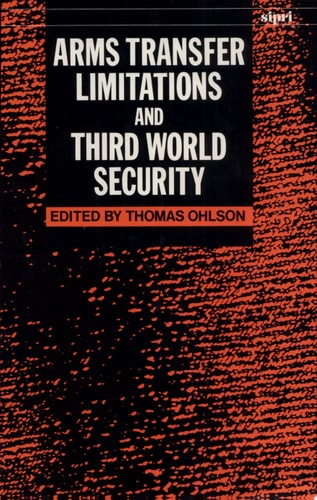
Arms Transfer Limitations and Third World Security
0
0
As an Amazon Associate and affiliate partner, Menrva Books earns from qualifying purchases. Learn more
Author Description
In light of recent international attention on the arms trade and its control, this study assesses past efforts, current proposals, and future opportunities to limit the transfer of weapons and military technology to Third World countries. The contributors, representing both supplier and recipient nations, consider all the sides of the issue, arguing that attempts at multilateral arms transfer limitations are more likely to succeed when initiated by recipients, and that there is an urgent need for confidence-building measures that will modify attitudes toward security, as well as other issues.
Menrva's Summary
THE THESIS
This study investigates the efficacy and feasibility of multilateral arms transfer limitations as a mechanism for enhancing security within developing nations. Thomas Ohlson, drawing on the research framework of the Stockholm International Peace Research Institute (SIPRI), synthesizes perspectives from both arms-exporting and arms-importing states. The text argues that successful arms control is contingent upon recipient-led initiatives and the implementation of confidence-building measures that address underlying security perceptions rather than merely restricting hardware flow.
THE SCOPE MAP
What You Will Find
- Analysis of historical efforts and contemporary proposals regarding global arms trade regulation.
- Evaluation of the geopolitical dynamics between supplier and recipient nations.
- Examination of confidence-building measures as a prerequisite for regional stability.
- Assessment of the relationship between military technology transfers and Third World security architectures.
THE AUTHORITY PERSPECTIVE
Experts recognize this monograph as a foundational text for understanding the complexities of Cold War-era arms proliferation and regional security. Readers frequently note the academic density of the prose and the systematic approach used to categorize the motivations of both global powers and developing states.
Page Count:
280
Publication Date:
1988-06-30
Publisher:
Stockholm International Peace Research Institute
ISBN-10:
0198291248
ISBN-13:
9780198291244
International relations
Arms Control
Arms Transfers
Military History
National security
Security Studies
Community Tags
Similar Books