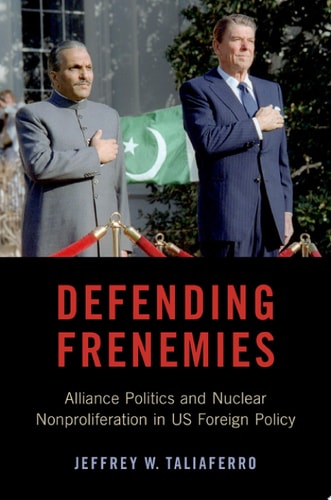
Defending Frenemies: Alliances, Politics, and Nuclear Nonproliferation in US Foreign Policy
0
0
As an Amazon Associate and affiliate partner, Menrva Books earns from qualifying purchases. Learn more
Author Description
The United States maintains defense ties with as many as 60 countries, which not only enables its armed forces to maintain command globally and to project its force widely, but also enables its government to exert leverage over allies' foreign policies and military strategies. In Defending Frenemies, Jeffrey W. Taliaferro presents a historical and comparative analysis of how successive US presidential administrations have employed inducements and coercive diplomacy toward Israel, Pakistan, South Korea, and Taiwan over nuclear proliferation. Taliaferro shows that the ultimate goals in each administration, from John F. Kennedy to George H. W. Bush, have been to contain the Soviet Union's influence in the Middle East and South Asia and to enlist China as an ally of convenience against the Soviets in East Asia. Policymakers' inclinations to pursue either accommodative strategies or coercive nonproliferation strategies toward allies have therefore been directly linked to these primary objectives. Defending Frenemies is sharp examination of how regional power dynamics and US domestic politics have shaped the nonproliferation strategies the US has pursued toward vulnerable and often obstreperous allies.
Menrva's Summary
THE THESIS
This book investigates how US presidential administrations balance the competing objectives of maintaining global defense alliances while simultaneously preventing nuclear proliferation among those same allies. Jeffrey W. Taliaferro, a professor of political science, utilizes historical case studies and archival research to argue that US nonproliferation strategies are not monolithic but are instead contingent upon broader geopolitical goals, specifically the containment of Soviet influence and the management of regional power dynamics. The author demonstrates that the choice between accommodation and coercion is driven by the perceived strategic value of the ally within the context of the Cold War and beyond.
THE SCOPE MAP
What You Will Find
- Historical analysis of US foreign policy from the Kennedy administration through the George H. W. Bush administration.
- Comparative case studies focusing on Israel, Pakistan, South Korea, and Taiwan.
- A framework for understanding the tension between security guarantees and nonproliferation goals.
Scope Limits
- The analysis does not extend into the post-Cold War era or contemporary nuclear proliferation challenges.
- The book does not provide a comprehensive history of the nuclear programs themselves, focusing instead on the diplomatic interactions between the US and the states in question.
THE AUTHORITY PERSPECTIVE
Scholars and foreign policy analysts recognize this work as a rigorous examination of the intersection between domestic political pressures and international security imperatives. Experts frequently highlight the book's utility in understanding the historical precedents for modern alliance management and coercive diplomacy.
Page Count:
310
Publication Date:
2019-01-01
Publisher:
Oxford University Press
ISBN-10:
0190939338
ISBN-13:
9780190939335
History
Military History
Nuclear Nonproliferation
Arms Control
Diplomacy
Alliances
International relations
Community Tags
Similar Books