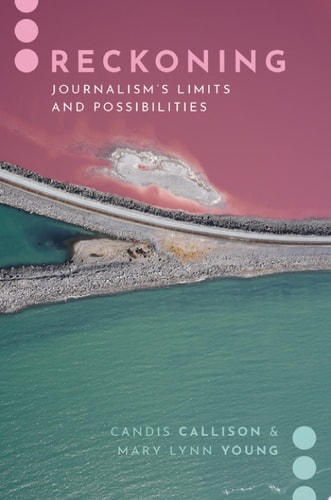
Reckoning: Journalism's Limits and Possibilities
0
0
As an Amazon Associate and affiliate partner, Menrva Books earns from qualifying purchases. Learn more
Author Description
How do journalists know what they know? Who gets to decide what good journalism is and when it's done right? What sort of expertise do journalists have, and what role should and do they play in society? Until a couple of decades ago, journalists rarely asked these questions, largely because the answers were generally undisputed. Now, the stakes are rising for journalists as they face real-time critique and audience pushback for their ethics, news reporting, and relevance. Yet the crises facing journalism have been narrowly defined as the result of disruption by new technologies and economic decline. This book argues that the concerns are in fact much more profound.Drawing on their five years of research with journalists in the U.S. and Canada, in a variety of news organizations from startups and freelancers to mainstream media, the authors find a digital reckoning taking place regarding journalism's founding ideals and methods. The book explores journalism's long-standing representational harms, arguing that despite thoughtful explorations of the role of publics in journalism, the profession hasn't adequately addressed matters of gender, race, intersectionality, and settler colonialism. In doing so, the authors rethink the basis for what journalism says it could and should do, suggesting that a turn to strong objectivity and systems journalism provides a path forward. They offer insights from journalists' own experiences and efforts at repair, reform, and transformation to consider how journalism can address its limits and possibilities along with widening media publics.
Menrva's Summary
THE THESIS
This book investigates the fundamental crisis of modern journalism by questioning the profession's traditional methods, ethical foundations, and its failure to address systemic societal inequities. Authors Candis Callison and Mary Lynn Young, both established scholars in media studies, utilize five years of empirical research across diverse North American news organizations to argue that journalism's current instability stems from deeper structural issues than mere technological or economic disruption. They propose a shift toward 'strong objectivity' and 'systems journalism' as a necessary framework for professional reform and social relevance.
THE SCOPE MAP
What You Will Find
- Five years of qualitative research conducted with journalists in the United States and Canada.
- Analysis of diverse news environments ranging from digital startups and independent freelancers to legacy media institutions.
- A critical examination of journalism's historical role in perpetuating harms related to race, gender, and settler colonialism.
- Theoretical proposals for 'strong objectivity' and 'systems journalism' as tools for institutional transformation.
Scope Limits
- The analysis focuses primarily on the North American media landscape and may not fully account for global journalistic practices.
- The text does not provide a technical manual for newsroom management but rather a theoretical and ethical critique of the profession.
THE AUTHORITY PERSPECTIVE
Scholars and media critics identify this work as a significant contribution to the discourse on journalistic ethics and institutional reform. Readers frequently note the academic density of the prose, which serves as a rigorous examination of the profession's internal contradictions and future possibilities.
Page Count:
334
Publication Date:
2019-12-31
Publisher:
Oxford University Press
ISBN-10:
0190067071
ISBN-13:
9780190067076
Politics
Reference
Communication
Communication Studies
Journalism
Sociology
Mass Communication
New Used & Rental Textbooks
Introduction to Human Communication
Writing Guides
Labor
Writing
Diplomacy
Media Studies
Human Resources
Words Language & Grammar