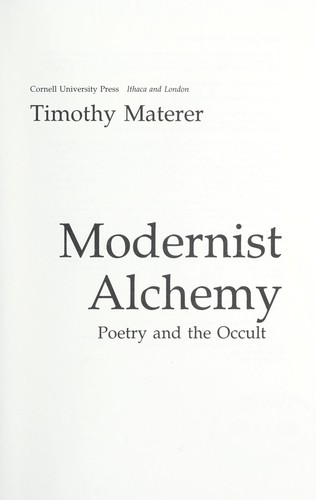
Modernist Alchemy
0
0
As an Amazon Associate and affiliate partner, Menrva Books earns from qualifying purchases. Learn more
Author Description
The occult has been a source of both ideas and images for modern poets from W. B. Yeats to James Merrill. Poets as diverse as Ezra Pound, H.D., Sylvia Plath, Robert Duncan, and Ted Hughes were both fascinated by, and skeptical of, such phenomena as alchemy and astrology, Ouija boards and Tarot cards, Indian mysticism, the kabbalah, and gnosticism. All of these poets, Timothy Materer says, approached the occult with a modernist sophistication and a self-consciousness that are not entirely credulous nor entirely skeptical. Modernist Alchemy takes a close look at the work of twentieth-century poets whose use of the occult constitutes a recovery of discarded beliefs and modes of thought: Yeats and Plath try to dismiss conventional religion, Hughes captures a sense of adventure, H.D. seeks to liberate repressed concepts, while Duncan and Merrill hunt for a lost understanding of sexual identity which will allow for androgyny and homosexuality. Materer ends with Merrill, whose attempt to suspend both doubt and belief marks the culmination of the poetic style initiated by Yeats.
Menrva's Summary
THE THESIS
This book investigates the complex relationship between modernist poetry and occult traditions. Timothy Materer examines how poets like W. B. Yeats, H.D., Sylvia Plath, Robert Duncan, Ted Hughes, and James Merrill engaged with phenomena such as alchemy, astrology, and mysticism. Materer argues that these poets approached the occult with a sophisticated, self-conscious modernist sensibility, neither fully credulous nor entirely skeptical. The work explores how their use of the occult served as a recovery of discarded beliefs and modes of thought, often to dismiss conventional religion, capture a sense of adventure, liberate repressed concepts, or explore issues of sexual identity.
THE SCOPE MAP
- Analysis of W. B. Yeats's engagement with the occult as a dismissal of conventional religion.
- Examination of H.D.'s use of occult themes to liberate repressed concepts.
- Exploration of Sylvia Plath's fascination with and skepticism towards occult phenomena.
- Discussion of Robert Duncan and James Merrill's search for understanding of sexual identity through occultism.
- Focus on Ted Hughes's capture of a sense of adventure through occult imagery.
- Analysis of James Merrill's approach as a culmination of modernist poetic style, suspending doubt and belief.
- Exploration of the occult as a source of both ideas and images for twentieth-century poets.
THE AUTHORITY PERSPECTIVE
The book is regarded as a scholarly examination of the intersection between modernist literature and occultism. It is noted for its close readings of key twentieth-century poets and its nuanced argument about their engagement with esoteric traditions. The work is appreciated for its detailed analysis of how poets like Yeats, Plath, and Merrill used occult beliefs to inform their artistic output and challenge conventional religious and philosophical frameworks. Materer's conclusion regarding Merrill's approach as a culmination of modernist style provides a significant interpretive lens.
Page Count:
218
Publication Date:
1995-01-01
ISBN-10:
0801431468
Poetry
History
Non-Fiction
Occult Studies
Modernism
Literary Criticism
Community Tags
Similar Books