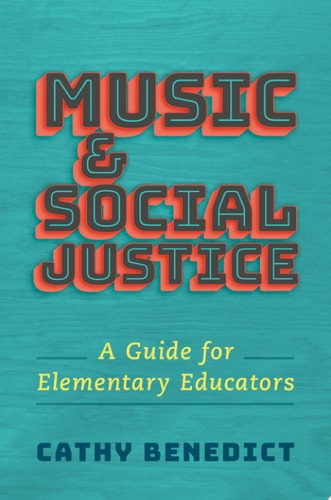
Music and Social Justice
0
0
As an Amazon Associate and affiliate partner, Menrva Books earns from qualifying purchases. Learn more
Author Description
In this book author Cathy Benedict challenges and reframes traditional ways of addressing many of the topics we have come to think of as social justice. Offering practical suggestions for helping both teachers and students think philosophically (and thus critically) about the world around them, each chapter engages with important themes through music making and learning as it presents scenarios, examples of dialogue with students, unit ideas and lesson plans geared toward elementary students (ages 6-14). Taken-for-granted subjects often considered beyond the understanding of elementary students such as friendship, racism, poverty, religion, and class are addressed and interrogated in such a way that honours the voice and critical thinking of the elementary student. Suggestions are given that help both teachers and students to pause, reflect and redirect dialogue with questions that uncover bias, misinformation and misunderstandings that too often stand in the way of coming to know and embracing difference. Guiding questions, which anchor many curricular mandates, are used throughout in order to scaffold critical and reflective thinking beginning in the earliest grades of elementary music education. Where does social justice reside? Whose voice is being heard and whose is being silenced? How do we come to think of and construct poverty? How is it that musics become used the way they are used? What happens to songs initially intended for socially driven purposes when their significance is undermined? These questions and more are explored encouraging music teachers to embrace a path toward socially just engagements at the elementary and middle school levels.
Menrva's Summary
THE THESIS
How can music educators effectively integrate critical philosophical inquiry into elementary curricula to address complex social justice issues? Author Cathy Benedict provides a framework for music teachers to move beyond traditional instruction by utilizing music as a vehicle for examining societal constructs. The text argues that elementary and middle school students possess the capacity for deep critical thought regarding topics such as poverty, racism, and class when provided with appropriate pedagogical scaffolding. By employing specific questioning techniques, Benedict demonstrates how educators can facilitate dialogue that uncovers bias and encourages an appreciation for diverse perspectives.
THE SCOPE MAP
What You Will Find
- Practical unit ideas and lesson plans for elementary music education (ages 6-14)
- Philosophical inquiry frameworks for classroom dialogue
- Strategies for identifying and redirecting student bias and misinformation
- Guiding questions designed to scaffold critical reflection
Scope Limits
- The text focuses primarily on the elementary and middle school music classroom environment
- It does not provide an exhaustive history of social justice movements outside the context of music pedagogy
THE AUTHORITY PERSPECTIVE
Educators and music pedagogy scholars frequently cite this work as a practical resource for integrating social consciousness into early music instruction. Experts highlight the text's effectiveness in providing actionable lesson plans that bridge the gap between abstract social theory and classroom application.
Page Count:
960
Publication Date:
2020-12-18
Publisher:
Oxford University Press Academic US
ISBN-10:
0190062142
ISBN-13:
9780190062149
Social Aspects
Instruction & Study
Music Education
Music
Inclusive Education
Elementary Education
history music
Education Elementary
Special Education
Social justice
Pedagogy
Education
Community Tags
Similar Books