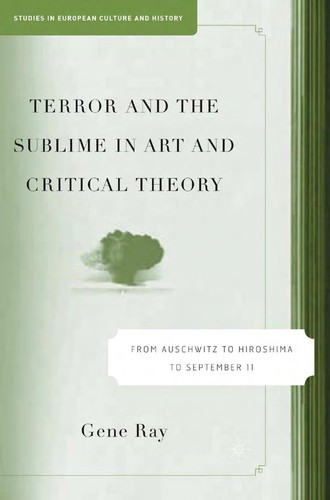
Terror and the Sublime in Art and Critical Theory: From Auschwitz to Hiroshima to September 11
0
0
As an Amazon Associate and affiliate partner, Menrva Books earns from qualifying purchases. Learn more
Author Description
The eleven interconnected essays of this book penetrate the dense historical knots binding terror, power, and the aesthetic sublime and bring the results to bear on the trauma of September 11 and the subsequent "war on terror." Through rigorous critical studies of major works of post- 1945 and contemporary culture, the book traces transformations in art and critical theory in the aftermath of Auschwitz and Hiroshima. Critically engaging with the work of continental philosophers Theodor W Adorno, Jacques Derrida, and Jean-Francois Lyotard and of contemporary artists Joeph Beuys, Damien Hirst, and Boaz Arad, the book confronts the shared cultural conditions that made Auschwitz and Hiroshima possible and offers searching meditations on the structure and meaning of the traumatic historical "event." Ray argues that globalization cannot be separated from the collective tasks of working through historical genocide. He provocatively concludes that the curent US-led "war on terror" must be grasped as a globalized inability to mourn.
Menrva's Summary
THE THESIS
This book investigates the complex relationship between terror, power, and the aesthetic sublime, particularly in the context of major historical traumas. Gene Ray examines how art and critical theory have grappled with the aftermath of Auschwitz, Hiroshima, and September 11th, tracing the evolution of thought and artistic expression in response to these events. The book engages with key continental philosophers and contemporary artists to explore the cultural conditions that enabled such atrocities and the meaning of traumatic historical moments. Ray posits that globalization is intrinsically linked to the process of working through historical genocide, concluding that the contemporary "war on terror" reflects a global failure to mourn.
THE SCOPE MAP
- Analysis of eleven interconnected essays exploring terror, power, and the aesthetic sublime.
- Focus on the trauma of September 11 and the subsequent "war on terror."
- Critical studies of major works of post-1945 and contemporary culture.
- Traces transformations in art and critical theory in the aftermath of Auschwitz and Hiroshima.
- Engages with philosophers Theodor W. Adorno, Jacques Derrida, and Jean-Francois Lyotard.
- Critically examines contemporary artists Joseph Beuys, Damien Hirst, and Boaz Arad.
- Confronts shared cultural conditions that made Auschwitz and Hiroshima possible.
- Offers meditations on the structure and meaning of traumatic historical "events."
THE AUTHORITY PERSPECTIVE
The book offers a rigorous critical examination of art and theory in the face of historical trauma. It engages deeply with philosophical concepts and artistic works to understand the cultural underpinnings of atrocities like Auschwitz and Hiroshima. The author's argument connects globalization with the collective task of processing genocide, suggesting that the "war on terror" is a manifestation of an inability to mourn. The work is positioned as a significant contribution to understanding the intersection of art, theory, and historical trauma in the contemporary world.
Page Count:
188
Publication Date:
2005-01-01
ISBN-10:
140396940X
Non-Fiction
Art
Philosophy
Horror
Globalization
Trauma Studies
Art History
Critical Theory
Community Tags
Similar Books