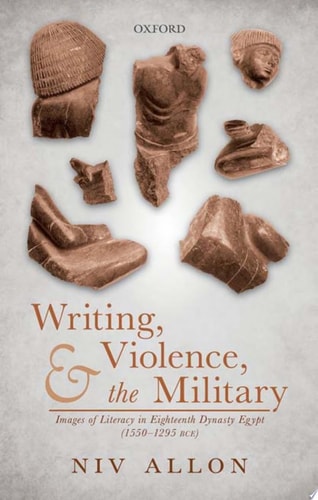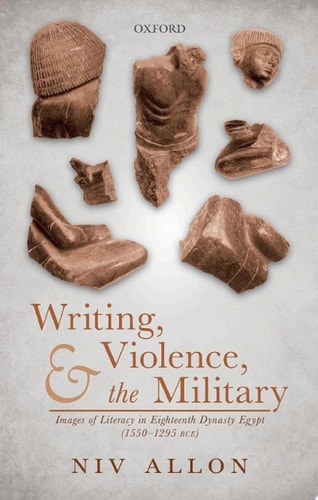
Writing, Violence, and the Military: Images of Literacy in Eighteenth Dynasty Egypt (1550-1295 BCE)
0
0
As an Amazon Associate and affiliate partner, Menrva Books earns from qualifying purchases. Learn more
Author Description
Writing, Violence, and the Military takes representations of reading and writing in Eighteenth Dynasty Egypt (ca. 1550-1295 BCE) as its point of departure, asking how patrons of art conceptualized literacy and how in turn they positioned themselves with respect to it. Exploring statuary and tomb art through the prism of self-representation and group formation, it makes three claims. Firstly, that the elite of this period held a variety of notions regarding literacy, among which violence and memory are most prominent. Secondly, that among the Eighteenth Dynasty elite, literacy found its strongest advocates among men whose careers brought them to engage with the military, either as military officials or as civil administrators who accompanied the army beyond the borders of Egypt. Finally, that Haremhab - the General in Chief who later ascended the throne - voiced unique views regarding literacy that arose from his career as an elite military official, and thus from his social world. Consequently, images of reading and writing allow us to study literacy with regard to those who commissioned them, and to consider these patrons' roles in changing conceptualizations. Throughout their different formulations, these representations call for a discussion on literacy in relation to self-representation and to art's role in society. They also invite us to reconsider our own approach to literacy and its significance in ancient times.
Menrva's Summary
THE THESIS
This work investigates how Eighteenth Dynasty Egyptian elites conceptualized literacy through the lens of self-representation and its intersection with military service. Niv Allon, an expert in Egyptology, utilizes a multidisciplinary approach to analyze statuary and tomb art from 1550-1295 BCE. He argues that literacy was not a monolithic concept but was deeply tied to notions of memory and violence, particularly among military officials and administrators who operated beyond Egypt's borders.
THE SCOPE MAP
What You Will Find
- Analysis of Eighteenth Dynasty statuary and tomb art as primary sources.
- A framework connecting literacy to social identity and group formation.
- A specific case study on the unique perspectives of Haremhab.
Scope Limits
- The study is restricted to the Eighteenth Dynasty (1550-1295 BCE).
- It focuses primarily on elite self-representation rather than broader literacy rates among the general populace.
THE AUTHORITY PERSPECTIVE
Scholars recognize this text as a nuanced contribution to the study of ancient Egyptian social history and visual culture. Experts highlight the author's ability to synthesize art historical analysis with sociopolitical theory to provide a fresh perspective on the role of the scribe in military contexts.
Page Count:
224
Publication Date:
2019-01-01
Publisher:
OUP Oxford
ISBN-10:
0192578707
ISBN-13:
9780192578709
History
Military History
Literacy Studies
Archaeology
Literacy
Art History
Generals
Ancient Egypt
Horemheb