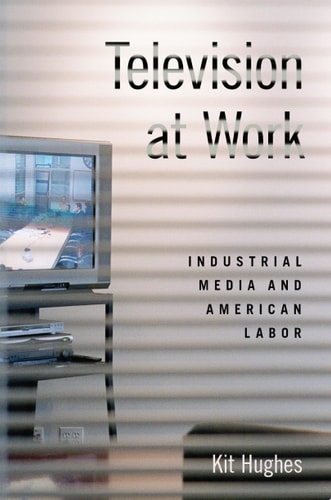
Television at Work: Industrial Media and American Labor
0
0
As an Amazon Associate and affiliate partner, Menrva Books earns from qualifying purchases. Learn more
Author Description
Television has never been exclusive to the home. In Television at Work, Kit Hughes explores the forgotten history of how U.S. workplaces used television to secure industrial efficiency, support corporate expansion, and manage the hearts, minds, and bodies of twentieth century workers.Challenging our longest-held understandings of the medium, Hughes positions television at the heart of a post-Fordist reconfiguration of the American workplace revolving around dehumanized technological systems. Among other things, business and industry built private television networks to distribute programming, created complex CCTV data retrieval systems, encouraged the use of videotape for worker self-evaluation, used video cassettes for training distributed workforces, and wired cantinas for employee entertainment. In uncovering industrial television as a prolific sphere of media practice, Television at Work reveals how labor arrangements and information architectures shaped by these uses of television were foundational to the rise of the digitally mediated corporation and to a globalizing economy.
Menrva's Summary
THE THESIS
This book investigates how the integration of television technology into the American workplace served as a mechanism for industrial efficiency and corporate control throughout the twentieth century. Kit Hughes, a scholar of media history, utilizes archival research and corporate records to argue that industrial television was a foundational element in the development of modern, digitally mediated labor structures. By examining the transition from Fordist to post-Fordist management, the author demonstrates how media architectures were deployed to monitor, train, and manage the workforce.
THE SCOPE MAP
What You Will Find
- Historical analysis of private television networks and CCTV systems in industrial settings.
- Examination of videotape usage for worker self-evaluation and training programs.
- Documentation of the shift toward globalized, distributed workforces mediated by video technology.
Scope Limits
- The text focuses primarily on the United States and does not provide an exhaustive global history of industrial media.
- It does not cover the consumer-facing history of television or domestic broadcasting trends.
THE AUTHORITY PERSPECTIVE
Scholars in media and labor studies recognize this work as a significant contribution to the history of corporate surveillance and internal communications. Readers frequently note the academic rigor of the research and the clarity with which the author connects historical media practices to contemporary digital labor conditions.
Page Count:
312
Publication Date:
2019-01-01
Publisher:
Oxford University Press
ISBN-10:
0190855819
ISBN-13:
9780190855819
Corporate History
Communication Studies
Technology and Society
Communications
Introduction to Human Communication
Media Studies
Radio
Labor history