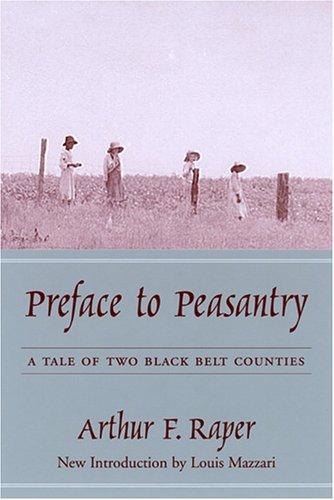
Preface to Peasantry
0
0
As an Amazon Associate and affiliate partner, Menrva Books earns from qualifying purchases. Learn more
Author Description
A social scientist and public intellectual, Arthur Raper (1899-1979) advocated unpopular solutions to combat the shortcomings of race relations and economic stagnation in the South. Originally published in 1936, Preface to Peasantry confirmed Raper's place in the Chapel Hill Southern Regionalist movement of the 1930s and 1940s and elaborated his belief that New Deal federal planning could create progressive social policies. The result of a seven-year investigation into social and economic stress in Georgia marked by African American emigration from the rural South to northern and New South cities, Raper's work focuses on the agricultural depression of Greene County, Georgia, bereft of farmable soil and with a rapidly declining black population, and the contrasting economic stability of Macon County, Georgia, where the land remained fertile and the population had not suffered significant upheaval. Arguing that the plantation system had taught African Americans only dependence and irresponsibility, Raper warned that, without social programs that materially altered the South's racial and economic policies, the course of events in Greene County and similar communities would drive African American tenant farmers and sharecroppers into a permanently subjugated peasant class.--BOOK JACKET.
Menrva's Summary
THE THESIS
This book investigates the social and economic conditions in the rural South during the Great Depression, particularly focusing on the impact of agricultural depression and racial policies on African American tenant farmers and sharecroppers. Arthur Raper, a social scientist and advocate for progressive policies, presents the findings of a seven-year investigation into Greene County and Macon County, Georgia. The study contrasts Greene County's agricultural decline and emigration with Macon County's relative stability, attributing these differences to land fertility and population retention. Raper argues that the legacy of the plantation system fostered dependence, and without significant social and economic reforms, African Americans risked becoming a permanently subjugated peasant class.
THE SCOPE MAP
- What You Will Find:
- An in-depth analysis of social and economic stress in Georgia during the 1930s.
- A comparative study of Greene County and Macon County, Georgia, highlighting differences in agricultural stability and population dynamics.
- Examination of the impact of the plantation system on African Americans, focusing on themes of dependence and responsibility.
- Discussion of the role of New Deal federal planning in creating progressive social policies.
- Analysis of African American emigration from the rural South to northern and New South cities.
- A warning about the potential for tenant farmers and sharecroppers to become a permanently subjugated peasant class without policy intervention.
THE AUTHORITY PERSPECTIVE
Originally published in 1936, 'Preface to Peasantry' solidified Arthur Raper's position within the Southern Regionalist movement. The book's detailed investigation into the socio-economic realities of the rural South, particularly its focus on the plight of African American sharecroppers, offered a critical perspective on the region's systemic issues. Raper's arguments regarding the necessity of federal intervention and social programs to counteract racial and economic stagnation were significant contributions to the discourse of the era. The work is recognized for its empirical approach and its advocacy for progressive policy solutions.
Page Count:
423
Publication Date:
1971-01-01
ISBN-10:
0405031211
History
Economics
Non-Fiction
Sociology
Community Tags
Similar Books