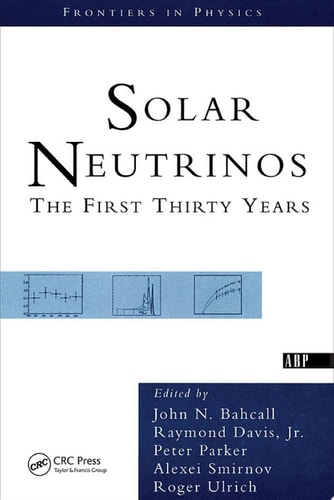
Solar Neutrinos
0
0
As an Amazon Associate and affiliate partner, Menrva Books earns from qualifying purchases. Learn more
Author Description
A variety of evolutionary sequences of models for the solar interior has been computed, corresponding to variations in input data, to obtain some idea of the uncertainties involved in predicting a solar neutrino flux. It is concluded that the neutrino flux can be estimated to within a factor of 2, the primary uncertainty being the initial homogeneous solar composition; detailed results are given. With a preferred value of the heavy-element-to-hydrogen ratio Z/X = 0.028, the helium content necessary to fit a model to the observed solar luminosity is found to be Y = 0.27.
Menrva's Summary
THE THESIS
This book investigates the uncertainties in predicting the solar neutrino flux by computing various evolutionary sequences of models for the solar interior. The authors, Jr. Davis, Roger Ulrich, and Sir Peter Parker, explore variations in input data to quantify these uncertainties. They conclude that the neutrino flux can be estimated within a factor of 2, with the primary uncertainty stemming from the initial homogeneous solar composition. Detailed results are provided, including a preferred value for the heavy-element-to-hydrogen ratio (Z/X = 0.028) and the corresponding helium content (Y = 0.27) required to match the observed solar luminosity.
THE SCOPE MAP
- Computation of evolutionary sequences for solar interior models.
- Analysis of uncertainties in predicting solar neutrino flux.
- Determination of the primary uncertainty source: initial solar composition.
- Estimation of solar neutrino flux within a factor of 2.
- Provision of detailed results, including Z/X and Y values.
- Use of Z/X = 0.028 as a preferred value for the heavy-element-to-hydrogen ratio.
- Calculation of helium content (Y = 0.27) to fit observed solar luminosity.
THE AUTHORITY PERSPECTIVE
This work presents a detailed computational analysis of solar models to address the prediction of solar neutrino flux. The authors focus on quantifying uncertainties, particularly those arising from the initial solar composition. The study provides specific numerical results and a preferred range for key parameters like the heavy-element-to-hydrogen ratio and helium content. The findings suggest a reliable estimation of neutrino flux within a factor of two, grounded in established astrophysical modeling techniques.
Page Count:
488
Publication Date:
2018-05-11
Publisher:
Taylor & Francis
ISBN-10:
0429982445
ISBN-13:
9780429982446
Science
Physics
Astronomy
Community Tags
Similar Books