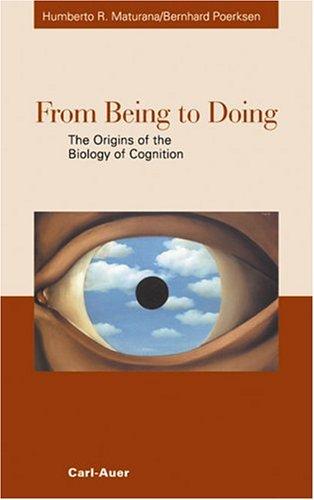
From Being to Doing
0
0
As an Amazon Associate and affiliate partner, Menrva Books earns from qualifying purchases. Learn more
Author Description
At the beginning of the last century, physicists revolutionised the scientific view of the world. Today biologists are radically transforming our understanding of the processes of life and cognition. Probing the mysteries of the mind, they have been able to prove that, in the act of knowing, the observer and the observed, subject and object, are inextricably enmeshed. The world we live in is not independent from us; we literally bring it forth ourselves. One of the protagonists of this new kind of thinking is the internationally renowned neurobiologist and systems theorist Humberto R. Maturana who was interviewed for several weeks by Bernhard Poerksen, journalist, and communication scientist. In this book, they explore the limits of our cognitive powers, discuss the truth in perception, the biology of love, and give, all in all, an introduction to systemic thinking that is down to earth, imaginative, and rich in anecdote.
Menrva's Summary
THE THESIS
This book explores the fundamental relationship between existence and action, challenging conventional understandings of life, cognition, and the observer's role in shaping reality. Humberto R. Maturana, a leading neurobiologist and systems theorist, engages in a dialogue with journalist Bernhard Poerksen to present a new perspective on biological processes and the nature of knowing. The authors argue that the act of cognition is not a passive reception of external reality but an active process where the observer and the observed are inseparable, leading to the conclusion that our perceived world is brought forth by our own biological and cognitive structures. This work introduces systemic thinking through accessible explanations, imaginative concepts, and engaging anecdotes.
THE SCOPE MAP
- Exploration of the biological basis of cognition and consciousness.
- Discussion on the observer's role in the act of knowing and perception.
- Introduction to systemic thinking and its application to understanding life.
- Analysis of the relationship between being and doing.
- Examination of the biology of love and emotion.
- Consideration of the limits of human cognitive powers.
- Dialogue format between a scientist and a communication scientist.
THE AUTHORITY PERSPECTIVE
The book is presented as an accessible introduction to systemic thinking by a renowned neurobiologist, Humberto R. Maturana. The dialogue format with journalist Bernhard Poerksen aims to make complex ideas about life, cognition, and the observer's role in reality understandable. The reception is likely to be positive among those interested in systems theory, biology, and philosophy, appreciating the blend of scientific rigor with imaginative and anecdotal explanations. It offers a perspective that challenges traditional dualisms between subject and object, observer and observed, suggesting a more integrated view of existence and knowledge.
Page Count:
208
Publication Date:
2004-01-01
ISBN-10:
1932462155
ISBN-13:
9781932462159
Science
Non-Fiction
Philosophy
Systems Theory
Biology
Cognition
Neurobiology
Community Tags
Similar Books