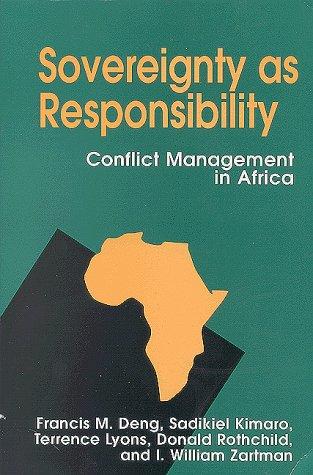
Sovereignty As Responsibility
0
0
As an Amazon Associate and affiliate partner, Menrva Books earns from qualifying purchases. Learn more
Author Description
Sovereignty, according to the authors, can no longer be seen as a protection against interference, but as a charge of responsibility where the state is accountable to both domestic and external constituencies. In internal conflicts in Africa, sovereign states have often failed to take responsibility for their own citizens' welfare and for the humanitarian consequences of conflict, leaving the victims with no protection or assistance. This book shows how that responsibility can be exercised by states over their own populations and by other states in assistance to their fellow sovereigns. The authors present a framework that should guide both national governments and the international community in discharging their respective responsibilities. They develop broad principles by examining identity as a potential source of conflict, governance as a matter of managing conflict, and economics as a policy field for conflict prevention. Considering conflict management, political stability, economic development, and social welfare as functions of governance, they also develop strategies, guidelines, and roles for its responsible exercise. Approaching conflict management from the perspective of the responsibilities of sovereignty provides a framework for evaluating government accountability. It proposes standards that guide performance and sharpen tools of conflict prevention rather than simply making post hoc judgments on success or failure. The authors demonstrate that sovereignty as responsibility is both a national obligation and a global imperative.
Menrva's Summary
THE THESIS
This book redefines sovereignty not as an inviolable right against external interference, but as a fundamental charge of responsibility towards a state's own citizens and the international community. The authors argue that in many African nations, the traditional concept of sovereignty has failed to ensure the welfare and protection of citizens, particularly during internal conflicts. They propose a new framework where states are accountable for humanitarian consequences and where other nations can assist in fulfilling these responsibilities. The book examines identity, governance, and economics as key areas for the responsible exercise of sovereignty, offering principles and strategies for national governments and international bodies alike.
THE SCOPE MAP
- What You Will Find:
- A redefinition of sovereignty as a responsibility, not merely a right.
- Analysis of the failure of traditional sovereignty in African internal conflicts.
- Framework for exercising state responsibility over populations.
- Guidelines for international assistance to fellow sovereigns.
- Examination of identity, governance, and economics as conflict drivers and prevention tools.
- Strategies and roles for responsible governance in conflict management, political stability, economic development, and social welfare.
- A perspective on government accountability through the lens of sovereignty as responsibility.
THE AUTHORITY PERSPECTIVE
The book posits that sovereignty entails a dual responsibility: to one's own citizens and to the global community, particularly in addressing humanitarian crises arising from internal conflicts. It offers a framework for national governments and international actors to operationalize this concept, focusing on identity, governance, and economic policy as crucial elements for conflict prevention and management. The authors advocate for a proactive approach that evaluates government accountability based on the responsible exercise of sovereignty, rather than solely on post-conflict outcomes. This perspective frames sovereignty as both a national obligation and a global imperative.
Page Count:
265
Publication Date:
1996-01-01
ISBN-10:
0815718284
Non-Fiction
Politics
International relations
Conflict Resolution
Community Tags
Similar Books