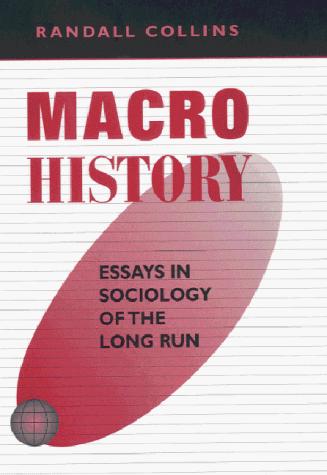
Macrohistory
0
0
As an Amazon Associate and affiliate partner, Menrva Books earns from qualifying purchases. Learn more
Author Description
This book explores the accomplishments of the golden age of "macrohistory," the sociologically informed analysis of long-term patterns of political, economic, and social change that has reached new heights of sophistication in the last decades of the twentieth century. It describes the scholarly revolution that has taken place in the Marxian-inspired theory of revolutions, the shift to a state-breakdown model in which revolutions, rather than bubbling up from discontent below, start at the top in the fiscal strains of the state. The author links revolutions to military-centered transformations of the state, and reviews how he used this theory in the early 1980s to predict the breakdown of the Soviet empire. Using this new theoretical tool, the author argues that Anglophone scholars have polemically misinterpreted German history, and that the roots of the Holocaust cannot be determined by German-bashing but must be attributed to processes that affect all of us.--BOOK JACKET.
Menrva's Summary
THE THESIS
This book investigates the evolution and application of macrohistory as a framework for understanding long-term societal transformations. Randall Collins, a prominent sociologist, draws upon Marxian-inspired theories to present a state-breakdown model of revolutions, arguing that these events originate from the fiscal pressures on states rather than popular discontent. He connects revolutions to military-driven state changes and reviews his early 1980s prediction of the Soviet empire's collapse, demonstrating the utility of this theoretical tool.
THE SCOPE MAP
- Exploration of the golden age of macrohistory and its sophisticated analysis of long-term political, economic, and social change.
- Detailed examination of the scholarly revolution in Marxian-inspired theory of revolutions.
- Presentation of the state-breakdown model, where revolutions begin at the top due to state fiscal strains.
- Linking of revolutions to military-centered transformations of the state.
- Review of the author's early 1980s prediction of the Soviet empire's breakdown using this theory.
- Argument that Anglophone scholars have polemically misinterpreted German history.
- Attribution of the roots of the Holocaust to processes affecting all societies, rather than solely to German actions.
THE AUTHORITY PERSPECTIVE
The book presents a significant theoretical framework for understanding historical change, particularly revolutions and state breakdown. The author's application of macrohistory to interpret German history and the Holocaust suggests a controversial but thought-provoking perspective. The work is likely to appeal to scholars and students of sociology, history, and political science interested in grand theories of societal development. Its analytical approach aims to provide a more universal understanding of historical processes.
Page Count:
312
Publication Date:
1999-01-01
ISBN-10:
0804735239
History
Non-Fiction
Philosophy
Economics
Sociology
Community Tags
Similar Books