
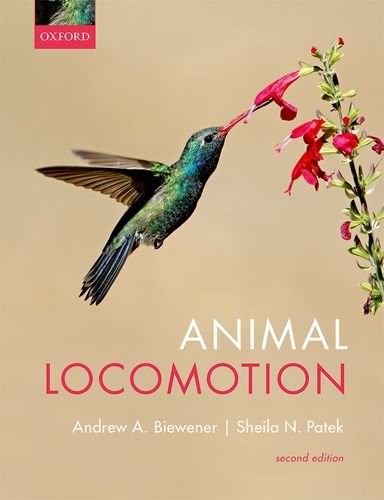
Animal Locomotion
0
0
As an Amazon Associate and affiliate partner, Menrva Books earns from qualifying purchases. Learn more
Author Description
This book provides a clear foundation, based on physical biology and biomechanics, for understanding the underlying mechanisms by which animals have evolved to move in their physical environment. It integrates the biomechanics of animal movement with the physiology of animal energetics an the neural control of locomotion. The author also communicates a sense of the awe and fascination that comes from watching the grace, speed, and power of animals in motion.Movement is a fundamental distinguishing feature of animal life, and a variety of extremely effective mechanical and physiological designs have evolved. Common themes are observed for the ways in which animals successfully contend with the properties of a given physical environment across diversity of life forms and varying locomotor modes. Understanding the common principles of design that span a diverse array of animals requires a broad comparative and integrative approach to their study. This theme persists throughout the book, as various modes and mechanisms of animal locomotion are covered. Since an animal's size is equally critical to its functional design, the effects of scale on locomotor energetics and mechanics are also discussed.Biewener begins by examining the underlying machinery for movement: skeletal muscles used for force generation, skeletons used for force transmission, and spring-like elements used for energy savings. He then describes the basic mechanisms that animals have evolved to move over land, in and on the surface of the water, and in the air. Common fluid dynamic principles are discussed as background to both swimming and flight. In addition to discussing the locomotor mechanisms of complex animals, the locomotor movement of single cells is also covered. Common biochemical features of cellular metabolism are then reviewed before discussing the energetic aspects of various locomotor modes. Strategies for conserving energy and moving economically are again highlighted in this section of
Menrva's Summary
THE THESIS
This book investigates the fundamental mechanical and physiological principles that govern how diverse animal species navigate their physical environments. Andrew A. Biewener, a specialist in comparative biomechanics, synthesizes data from skeletal muscle function, neural control, and metabolic energetics to explain the evolution of movement. The text argues that by examining the constraints of scale and environment, one can identify common design patterns across the animal kingdom.
THE SCOPE MAP
What You Will Find
- Analysis of skeletal muscle force generation and force transmission mechanisms.
- Comparative study of locomotor modes including terrestrial, aquatic, and aerial movement.
- Examination of the effects of body size and scaling on locomotor energetics.
- Integration of fluid dynamics principles as they apply to swimming and flight.
- Review of cellular-level movement and biochemical metabolic features.
THE AUTHORITY PERSPECTIVE
Experts recognize this work as a foundational text for students and researchers interested in the intersection of physics and biology. Readers frequently note the technical density of the prose, which effectively bridges the gap between mechanical engineering concepts and biological function.
Page Count:
296
Publication Date:
2003-08-28
Publisher:
Oxford University Press
ISBN-10:
0198500238
ISBN-13:
9780198500230
Science
Zoology
Biology
Biomechanics
Physiology
Community Tags
Other Editions(2)
Similar Books















Reader Comments
Share Your Thoughts
No comments yet. Be the first to share your thoughts!