Tokamaks
0
0
As an Amazon Associate and affiliate partner, Menrva Books earns from qualifying purchases. Learn more
Author Description
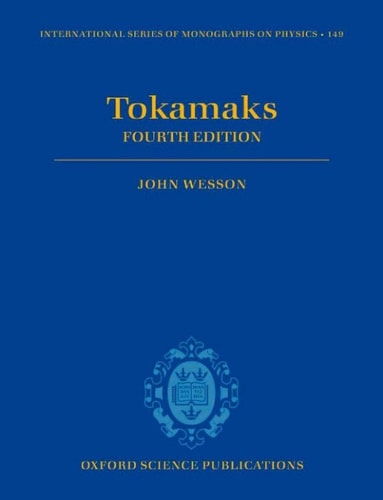
The tokamak (a doughnut-shaped vacuum chamber surrounded by magnetic coils) is the principal tool in controlled fusion research. This book acts as an introduction to the subject and a basic reference for theory, definitions, equations and experimental results. Since the first introductory account of tokamaks in 1987, when the tokamak had become the predominant device in the attempt to achieve a useful power source from the thermonuclear fusion, and the developments and advances in the subject covered in the second edition in 1997, following substantial research on large tokamaks (the long awaited achievement of significant amounts of fusion power and the problems involved in designing and building a tokamak reactor), the emphasis has been on preparing the ground for an experimental reactor. In addition, there have been further significant advanced in understanding plasma behavior, such as the wider experience of internal transport barriers, the appreciation of the role of tearing models driven by neoclassical effects and insights from turbulence simulations. The third edition brings all of this up-to-date, building on the introductory account and developments of the first and second editions.
Menrva's Summary
THE THESIS
This text investigates the physical principles, theoretical frameworks, and experimental challenges inherent in the development of tokamak devices for controlled thermonuclear fusion. John Wesson, a recognized authority in plasma physics, synthesizes decades of research to provide a comprehensive overview of the tokamak as a viable power source. The book serves as both an educational introduction and a technical reference, detailing the evolution of fusion research from early experiments to the design requirements of modern experimental reactors.
THE SCOPE MAP
What You Will Find
- Theoretical foundations of plasma behavior and magnetic confinement
- Analysis of internal transport barriers and neoclassical tearing modes
- Technical data on turbulence simulations and reactor design constraints
- Historical progression of fusion research and experimental results from large-scale tokamaks
THE AUTHORITY PERSPECTIVE
Experts and researchers frequently cite this work as a foundational reference for understanding the complexities of magnetic confinement fusion. Readers often note the high level of technical density, making it a standard resource for graduate students and professionals in the field of plasma physics.
Page Count:
768
Publication Date:
2004-01-29
Publisher:
Oxford University Press
ISBN-10:
0198509227
ISBN-13:
9780198509226
Science
Reference
Engineering
Physics
Nuclear Energy