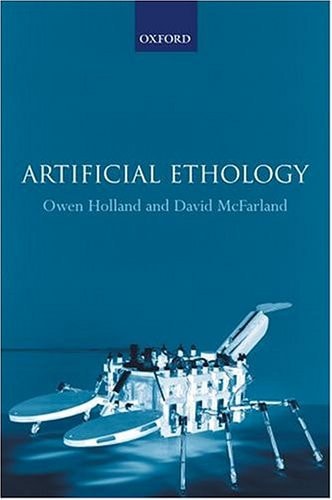
Artificial Ethology
0
0
As an Amazon Associate and affiliate partner, Menrva Books earns from qualifying purchases. Learn more
Author Description
Product DescriptionArtificial ethology is an exciting new field of research that explores the ways that we can use robots and robotics to enhance our understanding of how real animals behave. Modelling and computer simulations combined with empirical research are the traditional tools of animal behavior. Thisnew text sets out to show how experimentation with animal-like robots can add a new dimension to our understanding of behavioral questions. Introductory chapters explain the history of the use of models in animal behavior, and describe how animal like mobile robots 'evolved' during the developmentof the discipline. Then thematic chapters scrutinize sensory processes and orientation, motor co-ordination, and motivation and learning in turn. Each thematic exploration is exemplified by a series of case studies, written by some of the leading researchers in artificial ethology. From roboticlobsters to robot crickets and robot 'sheepdogs', each of these case studies give a detailed description of a particular problem, research approach, and robot application. The examples bring the text to life, and will enable students to get an in- depth picture of the potential and thepracticalities of this research. The text concludes with a discussion of general points arising from the use of robots in biological research, and the rationale for using real robots as opposed to simulation. Aimed at advanced students taking courses in animal behavior, the text should also be ofinterest to computer scientists and engineers interested in robotics, artificial intelligence, and the study of biological systems.About the Author Owen Holland, Intelligent Autonomous Systems Laboratory, Faculty of Engineering, University of the West of England, Coldharbour Lane, Frenchay, Bristol BS16 1QY Currently a visiting research fellow at Caltech: owen@micro.caltech.edu David MacFarland, Animal Behaviour Unit, Department of Zoology, University of Oxford, Oxford, UK. david.mcfarland@zoology.oxford.ac.u
Menrva's Summary
THE THESIS
This text investigates how the integration of robotics into ethological research provides a novel experimental framework for understanding animal behavior. Authors David McFarland and Owen Holland, both established academics in zoology and intelligent systems, argue that physical robotic models offer distinct advantages over traditional computer simulations by allowing researchers to test behavioral hypotheses in real-world environments. The book synthesizes historical context with contemporary case studies to demonstrate the practical application of artificial agents in biological inquiry.
THE SCOPE MAP
What You Will Find
- Historical development of modeling techniques in animal behavior studies
- Analysis of sensory processes, motor coordination, and motivation in artificial systems
- Case studies featuring diverse robotic models, including lobsters, crickets, and sheepdogs
- Comparative evaluation of physical robotics versus pure computer simulation
THE AUTHORITY PERSPECTIVE
Experts recognize this work as a foundational text for students and researchers bridging the gap between biological sciences and robotics. Readers frequently note the technical depth of the case studies, which provide a clear look at the practical challenges inherent in artificial ethology.
Page Count:
272
Publication Date:
2001-09-15
Publisher:
Oxford University Press
ISBN-10:
0198504969
ISBN-13:
9780198504962
Science
Robotics
Biology
Engineering
Community Tags
Other Editions(2)
Similar Books







Reader Comments
Share Your Thoughts
No comments yet. Be the first to share your thoughts!