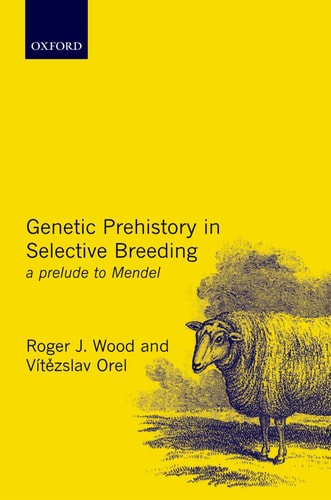
Genetic Prehistory in Selective Breeding: A Prelude to Mendel
0
0
As an Amazon Associate and affiliate partner, Menrva Books earns from qualifying purchases. Learn more
Author Description
Long before Mendel's ground-breaking discoveries about heredity, sheep breeders in the eighteenth and nineteenth centuries were transforming the appearance and qualities of their livestock by combining various traits of body and wool into new patterns. Exploiting what were then novel procedures - individual trait selection, close inbreeding and progeny testing - they demonstrated inheritance from both sexes and showed how it could be stabilized. This remarkable book examines how sheep breeding contributed to the early knowledge of heredity and how the theory was pursued during the early nineteenth century in Brno, where Mendel would later define the basis of genetics. Drawing from extensive records and scientific and social literature, the authors tell the fascinating story of experimental sheep breeding from a pan-European perspective, stressing its progress through empirical discovery and the spread of Merino sheep into northern Europe and Australia. The book provides detailed coverage of the Brno Sheep Breeder's Society and its role in the development of ideas about heredity, a comprehensive review of Robert Bakewell's sheep breeding achievements, and the impact of this work on Mendel's own education and professional research. This profound and entertaining work is destined to be a classic for historians and students of science as well as practitioners in all areas of scientific study.
Menrva's Summary
THE THESIS
This book investigates the historical intersection between eighteenth-century selective sheep breeding practices and the subsequent development of Mendelian genetics. Authors Roger J. Wood and Vítězslav Orel utilize extensive archival records and historical scientific literature to argue that empirical breeding techniques provided a foundational framework for understanding heredity long before Gregor Mendel formalized his laws. By examining the social and scientific climate of nineteenth-century Brno, the authors demonstrate how practical agricultural advancements directly informed the theoretical breakthroughs that defined modern genetics.
THE SCOPE MAP
What You Will Find
- Historical analysis of eighteenth and nineteenth-century sheep breeding methodologies including individual trait selection and progeny testing.
- Detailed examination of the Brno Sheep Breeder's Society and its influence on early hereditary theory.
- Comprehensive review of Robert Bakewell's contributions to livestock improvement and genetic stabilization.
- Documentation of the spread of Merino sheep across Europe and Australia as a catalyst for empirical scientific discovery.
THE AUTHORITY PERSPECTIVE
Historians of science and genetics researchers frequently cite this work for its meticulous archival research and its ability to contextualize Mendel's work within a broader agricultural tradition. Experts highlight the text as a valuable resource for understanding the pre-Mendelian empirical landscape of biological inheritance.
Page Count:
344
Publication Date:
2001-09-27
Publisher:
Oxford University Press
ISBN-10:
0198505841
ISBN-13:
9780198505846
Non-Fiction
Sheep
Genetics
Agriculture
Biology
Community Tags
Similar Books