
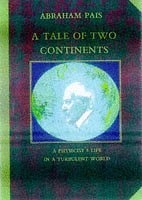
A Tale of Two Continents: A Physicist's Life in a Turbulent World
0
0
As an Amazon Associate and affiliate partner, Menrva Books earns from qualifying purchases. Learn more
Author Description
People like myself, who truly feel at home in several countries, are not strictly at home anywhere, writes Abraham Pais, one of the world's leading theoretical physicists, near the beginning of this engrossing chronicle of his life on two continents. The author of an immensely popular biography of Einstein, Subtle is the Lord. Pais writes engagingly for a general audience. His tale describes his period of hiding in Nazi-occupied Holland (he ended the war in a Gestapo prison) and his life in America, particularly at the newly organised Institute for Advanced Study in Princeton, then directed by the brilliant and controversial physicist Robert Oppenheimer. Pais tells fascinating stories about Oppenheimer, Einstein, Bohr, Sakharov, Dirac, Heisenberg, and von Neumann, as well as about nonscientists like Chaim Weizmann, George Kennan, Erwin Panofsky, and Pablo Casals. His enthusiasm about science and life in general pervades a book that is partly a memoir, partly a travel commentary, and partly a history of science. Pais's charming recollections of this years as a university student become somber with the German invasion of the Netherlands in 1940. He was presented with an unusual deadline for his graduate work: a German decree that July 14, 1941, would be the final date on which Dutch Jews could be granted a doctoral degree. Pais received the degree, only to be forced into hiding from the Nazis in 1943, practically next door to Anne Frank. After the war, he went to the Institute of Theoretical Physics in Copenhagen to work with Niels Bohr. 1946 began his years at the Institute for Advanced Study, where he worked first as a Fellow and then as a Professor until his move to Rockefeller University in 1963. Combining his understanding of disparate social and political worlds, Pais comments just as insightfully on Oppenheimer's ordeals during the McCarthy era as he does on his own and his European colleagues' struggles during World War II.
Menrva's Summary
THE THESIS
How does a life defined by scientific rigor and intellectual migration navigate the turbulence of twentieth-century political upheaval? Abraham Pais, a distinguished theoretical physicist, utilizes his personal trajectory to examine the intersection of private identity and public history. By documenting his experiences from Nazi-occupied Europe to the academic corridors of Princeton, he argues that the pursuit of scientific truth is inextricably linked to the social and political climates of the era. The text serves as both a historical record of the development of modern physics and a reflective study on the nature of displacement and belonging.
THE SCOPE MAP
What You Will Find
- Detailed accounts of the Nazi occupation of the Netherlands and the author's survival in hiding.
- First-hand observations of the intellectual culture at the Institute for Advanced Study in Princeton.
- Anecdotal portraits of prominent twentieth-century figures including Albert Einstein, Niels Bohr, and Robert Oppenheimer.
- Reflections on the impact of the McCarthy era on the scientific community.
THE AUTHORITY PERSPECTIVE
Experts and readers alike value this work for its unique synthesis of personal memoir and historical documentation of the physics community. The text is frequently cited for its balanced prose, which remains accessible to general readers while providing significant insight into the lives of foundational scientific figures.
Page Count:
527
Publication Date:
1999-07-31
Publisher:
Oxford University Press Inc, USA
ISBN-10:
0198505434
ISBN-13:
9780198505433
Memoir
History
Autobiography
Biography
Physics
Philosophy history
Community Tags
Other Editions(2)

Similar Books

Reader Comments
Share Your Thoughts
No comments yet. Be the first to share your thoughts!