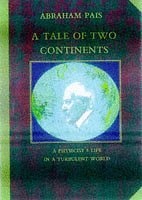
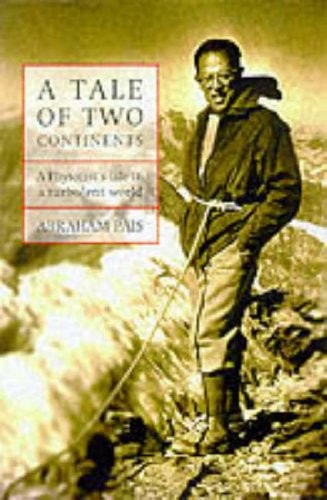
Tale of Two Continents: A Physicist's Life in a Turbulent World
0
0
As an Amazon Associate and affiliate partner, Menrva Books earns from qualifying purchases. Learn more
Author Description
"People like myself, who truly feel at home in several countries, are not strictly at home anywhere," writes Abraham Pais, one of the world's leading theoretical physicists, near the beginning of this engrossing chronicle of his life on two continents. The author of an immensely popular biography of Einstein, Subtle Is the Lord, Pais writes engagingly for a general audience. His "tale" describes his period of hiding in Nazi-occupied Holland (he ended the war in a Gestapo prison) and his life in America, particularly at the newly organized Institute for Advanced Study in Princeton, then directed by the brilliant and controversial physicist Robert Oppenheimer. Pais tells fascinating stories about Oppenheimer, Einstein, Bohr, Sakharov, Dirac, Heisenberg, and von Neumann, as well as about nonscientists like Chaim Weizmann, George Kennan, Erwin Panofsky, and Pablo Casals. His enthusiasm about science and life in general pervades a book that is partly a memoir, partly a travel commentary, and partly a history of science.Pais's charming recollections of his years as a university student become somber with the German invasion of the Netherlands in 1940. He was presented with an unusual deadline for his graduate work: a German decree that July 14, 1941, would be the final date on which Dutch Jews could be granted a doctoral degree. Pais received the degree, only to be forced into hiding from the Nazis in 1943, practically next door to Anne Frank. After the war, he went to the Institute of Theoretical Physics in Copenhagen to work with Niels Bohr. 1946 began his years at the Institute for Advanced Study, where he worked first as a Fellow and then as a Professor until his move to Rockefeller University in 1963. Combining his understanding of disparate social and political worlds, Pais comments just as insightfully on Oppenheimer's ordeals during the McCarthy era as he does on his own and his European colleagues' struggles during World War II.
Menrva's Summary
THE THESIS
This memoir investigates the intersection of personal identity and scientific advancement through the lens of a physicist navigating the geopolitical upheavals of the twentieth century. Abraham Pais, a prominent theoretical physicist and biographer of Albert Einstein, utilizes his own life experiences to examine the displacement of European intellectuals during World War II and the subsequent development of American academic institutions. By contrasting his formative years in Nazi-occupied Holland with his professional tenure at the Institute for Advanced Study, Pais constructs a narrative that bridges the gap between rigorous scientific inquiry and the human experience of historical trauma.
THE SCOPE MAP
What You Will Find
- Detailed accounts of the academic environment at the Institute for Advanced Study in Princeton during the mid-twentieth century.
- First-hand observations of prominent scientific figures including Niels Bohr, Robert Oppenheimer, and Albert Einstein.
- Historical documentation of the impact of Nazi occupation on Dutch academic life and the subsequent survival strategies of Jewish scholars.
- Reflections on the McCarthy era and its influence on the scientific community in the United States.
THE AUTHORITY PERSPECTIVE
Experts and readers alike recognize this work as a significant primary source for understanding the social history of physics in the post-war era. The prose is noted for its accessibility, effectively balancing technical context with the personal narrative of a witness to major historical events.
Page Count:
527
Publication Date:
1997-01-01
Publisher:
Princeton University Press
ISBN-10:
0198501994
ISBN-13:
9780198501992
Autobiography
Biography
History
Memoir
Physics
Philosophy history
Community Tags
Other Editions(2)
Similar Books

Reader Comments
Share Your Thoughts
No comments yet. Be the first to share your thoughts!