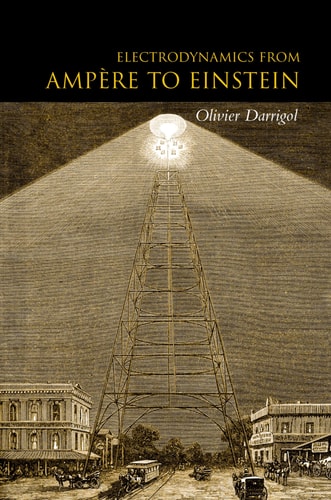
Electrodynamics from Ampère to Einstein
0
0
As an Amazon Associate and affiliate partner, Menrva Books earns from qualifying purchases. Learn more
Author Description
Three quarters of a century elapsed between Ampère's definition of electrodynamics and Einstein's reform of the concepts of space and time. The two events occurred in utterly different worlds: the French Academy of Sciences of the 1820s seems very remote from the Bern patent office of the early 1900s, and the forces between two electric currents quite foreign to the optical synchronization of clocks. Yet Ampère's electrodynamics and Einstein's relativity are firmly connected through an historical chain involving German extensions of Ampère's work, competition with British field conceptions, Dutch synthesis, and fin de siècle criticism of the aether-matter connection. Darrigol's book retraces this intriguing evolution, with a physicist's attention to conceptual and instrumental developments, and with an historian's awareness of their cultural and material embeddings. This book exploits a wide range of sources, and incorporates the many important insights of other scholars. Thorough accounts are given of crucial episodes such as Faraday's redefinition of charge and current, the genesis of Maxwell's field equations, or Hertz' experiments on fast electric oscillations. Thus emerges a vivid picture of the intellectual and instrumental variety of nineteenth century physics. The most influential investigators worked at the crossroads between different disciplines and traditions: they did not separate theory from experiment, they frequently drew on competing traditions, and their scientific interests extended beyond physics into chemistry, mathematics, physiology, and other areas. By bringing out these important features, this book offers a tightly connected and yet sharply contrasted view of early electrodynamics.
Menrva's Summary
THE THESIS
This book investigates the historical and conceptual evolution of electrodynamics from the early nineteenth-century work of Ampère to the relativistic reforms of Albert Einstein. Olivier Darrigol, a physicist and historian, utilizes a vast array of primary sources and scholarly insights to map the progression of electromagnetic theory. He argues that the development of this field was not a linear progression but a complex interplay of competing national traditions, experimental practices, and interdisciplinary influences that bridged the gap between French academy science and the early twentieth-century patent office environment.
THE SCOPE MAP
What You Will Find
- Detailed analysis of the transition from Ampère’s force-based electrodynamics to Maxwell’s field equations.
- Examination of the cultural and material contexts of nineteenth-century scientific institutions.
- Case studies on pivotal figures including Faraday, Hertz, and the Dutch school of synthesis.
- Exploration of the intersection between theoretical physics, mathematics, and experimental instrumentation.
THE AUTHORITY PERSPECTIVE
Experts recognize this work as a rigorous, scholarly examination of the history of physics that successfully balances technical detail with historical context. Readers frequently note the academic density of the prose, which is intended for those with a background in the history of science or physics.
Page Count:
552
Publication Date:
2000-08-10
Publisher:
Oxford University Press
ISBN-10:
0198505949
ISBN-13:
9780198505945
Non-Fiction
Science
Physics
Community Tags
Similar Books