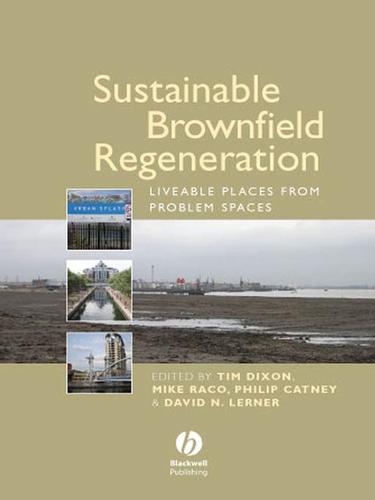
Sustainable Brownfield Regeneration
0
0
As an Amazon Associate and affiliate partner, Menrva Books earns from qualifying purchases. Learn more
Author Description
Sustainable Brownfield Regeneration presents a comprehensive account of UK policies, processes and practices in brownfield regeneration and takes an integrated and theoretically-grounded approach to highlight best practice. Brownfield regeneration has become a major policy driver in developed countries. It is estimated that there are 64,000 hectares of brownfield land in England, much of which presents severe environmental challenges and lies alongside some of the most deprived communities in the country. Bringing such land back into active use has taken on a new urgency among policymakers, developers and other stakeholders in the development process. Frequently, however, policy thinking and practice has been underpinned by 'silo' mentalities, in which integrated and multidisciplinary approaches to problem-solving have been limited. The book has two principal aims. The first is to examine the ways in which science and social science research disciplines can be brought together to help solve important brownfield regeneration issues, with a focus on the UK. The second is to assess the efficiency and effectiveness of different types of regeneration policy and practice, and to show how 'liveable spaces' can be produced from 'problem places'. The Thames Gateway in the south of England and Greater Manchester in the North of England are shown as examples of how brownfield regeneration projects are developing in an era where sustainability is high on the policy agenda. From the Foreword by Paul Syms, National Brownfield Advisor, English Partnerships: 'Ensuring the effective and efficient reuse of brownfield land is an essential part of the British Government's land use policies in support of sustainable communities. [This book] recognises that reusing brownfield land is not just about over-coming technical issues to remove contamination or other physical problems with the ground. It highlights the importance of engaging with the many different stakeholders whose opinions an
Menrva's Summary
THE THESIS
This book investigates the complex challenges and integrated solutions for regenerating brownfield sites in the UK. It addresses the significant environmental and social issues associated with these lands, aiming to transform 'problem places' into 'liveable spaces' through effective policy and practice. The author examines how scientific and social science research can be combined to tackle brownfield regeneration issues, focusing on the UK context and assessing the efficiency of various regeneration strategies.
THE SCOPE MAP
- What You Will Find:
- Analysis of UK policies, processes, and practices in brownfield regeneration.
- Integrated and theoretically-grounded approach to identifying best practices.
- Examination of the intersection of science and social science in brownfield issues.
- Assessment of the efficiency and effectiveness of different regeneration policies and practices.
- Case studies of Thames Gateway and Greater Manchester as examples of regeneration projects.
- Discussion on overcoming technical challenges and engaging diverse stakeholders.
THE AUTHORITY PERSPECTIVE
The book is recognized for its comprehensive account of UK brownfield regeneration, integrating policy, process, and practice with a strong theoretical foundation. It highlights the critical need for multidisciplinary approaches to address the environmental and social challenges presented by brownfield sites. The inclusion of case studies from Thames Gateway and Greater Manchester provides practical examples of sustainability-focused regeneration efforts. The foreword by Paul Syms of English Partnerships underscores the book's alignment with government policies for sustainable communities.
Page Count:
400
Publication Date:
2008-01-01
ISBN-10:
1405144033
ISBN-13:
9780470691403
Politics
Economics
Non-Fiction
Sustainability
urban planning
Community Tags
Similar Books