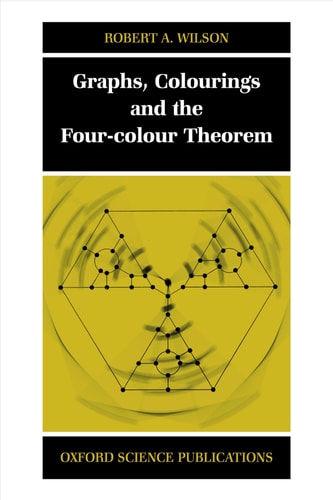
Graphs, Colourings and the Four-Colour Theorem
0
0
As an Amazon Associate and affiliate partner, Menrva Books earns from qualifying purchases. Learn more
Author Description
The four-colour theorem is one of the famous problems of mathematics, that frustrated generations of mathematicians from its birth in 1852 to its solution (using substantial assistance from electronic computers) in 1976. The theorem asks whether four colours are sufficient to colour all conceivable maps, in such a way that countries with a common border are coloured with different colours. The book discusses various attempts to solve this problem, and some of the mathematics which developed out of these attempts. Much of this mathematics has developed a life of its own, and forms a fascinating part of the subject now known as graph theory. The book is designed to be self-contained, and develops all the graph-theoretical tools needed as it goes along. It includes all the elementary graph theory that should be included in an introduction to the subject, before concentrating on specific topics relevant to the four-colour problem. Part I covers basic graph theory, Euler's polyhedral formula, and the first published false proof of the four-colour theorem. Part II ranges widely through related topics, including map-colouring on surfaces with holes, the famous theorems of Kuratowski, Vizing, and Brooks, the conjectures of Hadwiger and Hajos, and much more besides. In Part II we return to the four-colour theorem, and study in detail the methods which finally cracked the problem.
Menrva's Summary
THE THESIS
This book investigates the mathematical history and technical resolution of the four-colour theorem, a problem that challenged mathematicians for over a century. Robert A. Wilson, a mathematician with expertise in group theory and combinatorics, provides a structured framework that bridges elementary graph theory with the complex computational methods required to prove the theorem. The text serves as both an introduction to the field and a detailed analysis of the specific topological and algebraic developments that emerged from the quest to solve map-colouring problems.
THE SCOPE MAP
What You Will Find
- Comprehensive coverage of basic graph theory and Euler's polyhedral formula.
- Detailed examination of historical attempts and false proofs of the four-colour theorem.
- Technical analysis of map-colouring on surfaces with varying topological properties.
- Discussion of foundational theorems by Kuratowski, Vizing, and Brooks alongside conjectures by Hadwiger and Hajos.
THE AUTHORITY PERSPECTIVE
Experts recognize this work as a highly accessible yet rigorous introduction to graph theory that successfully contextualizes the four-colour theorem within broader mathematical history. Readers frequently note the clarity of the prose, which balances foundational instruction with the technical depth required for advanced study.
Page Count:
154
Publication Date:
2002-03-28
Publisher:
Oxford University Press
ISBN-10:
0198510624
ISBN-13:
9780198510628
Science
Academic
Mathematics
Graph Theory