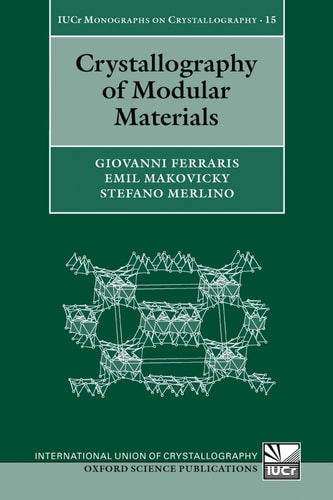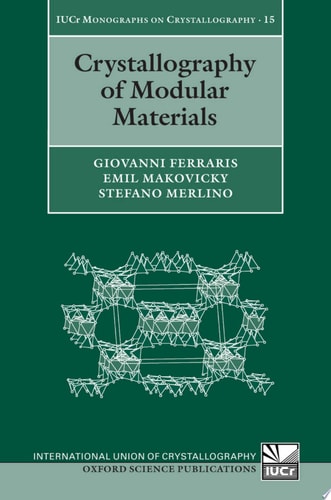
Crystallography of Modular Materials
0
0
As an Amazon Associate and affiliate partner, Menrva Books earns from qualifying purchases. Learn more
Author Description
This is the first book to provide a comprehensive treatment of theories and applications in the rapidly expanding field of the crystallography of molecular materials. Molecules are the natural modules from which molecular crystalline structures are built. Most inorganic structures, however are infinite arrays of atoms and some kinds of surrogate modules, e.g. coordination polyhedra, are usually used to describe them. In recent years, the attention has been focused on complex modules as the basis for a systematic description of polytypes and homologous/polysomatic series (modular structures). This representation is applied to the modeling of unknown structures and understanding nanoscale defects and intergrowths in materials. He Order/Disorder (OD) theory is fundamental to developing a systematic theory of polytypism, dealing with those structures based on both ordered and disordered stacking of one or more layers. Twinning at both unit-cell and micro-scale, together with disorder, causes many problems, "demons", for computer-based methods of crystal structure determination. This book develops the theory of twinning with the inclusion of worked examples, converting the "demons" into useful indicators for unravelling crystal structure. In spite of the increasing use of the concepts of modular crystallography for characterizing, understanding and tailoring technological crystalline materials, this is the first book to offer a unified treatment of the results, which are spread across many different journals and original papers published over the last twenty years.
Menrva's Summary
THE THESIS
This book investigates the systematic application of modular crystallography to describe complex inorganic structures, polytypes, and homologous series. The authors, Emil Makovicky, Giovanni Ferraris, and Stefano Merlino, synthesize two decades of research to provide a unified theoretical framework for understanding materials built from complex modules. By addressing the challenges of Order/Disorder (OD) theory and structural twinning, the text offers a methodology for modeling unknown structures and interpreting nanoscale defects.
THE SCOPE MAP
What You Will Find
- Theoretical foundations of modular crystallography and polytypism.
- Application of Order/Disorder (OD) theory to layered structures.
- Methodologies for identifying and utilizing twinning as a diagnostic tool.
- Modeling techniques for complex inorganic structures and nanoscale intergrowths.
THE AUTHORITY PERSPECTIVE
Experts recognize this monograph as a foundational resource for researchers navigating the complexities of modular materials and crystal structure determination. Readers frequently note the high level of technical density, making it a primary reference for advanced students and professionals in the field of crystallography.
Page Count:
384
Publication Date:
2004-06-03
Publisher:
Oxford University Press
ISBN-10:
0198526644
ISBN-13:
9780198526643
Science
Chemistry
Physics