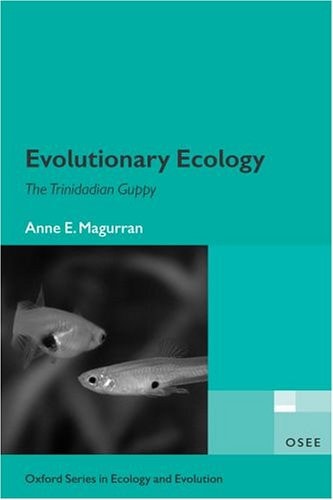
Evolutionary Ecology: The Trinidadian Guppy
0
0
As an Amazon Associate and affiliate partner, Menrva Books earns from qualifying purchases. Learn more
Author Description
This book celebrates the guppy's unique contribution to evolutionary ecology. Ever since Caryl Haskins described guppy populations as a 'natural experiment' because of the way predation pressure varies over a small geographical area, generations of researchers have been drawn to Trinidad to investigate evolution in the wild. The species continues to provide classic examples of natural selection in action and elegantly illustrates how ecology, evolution, and behaviour are interlinked.Anne Magurran's account of the evolutionary ecology of the guppy integrates historical breakthroughs with new research in this fast-moving field. She reveals how guppies provided some of the first evidence of sperm competition and sexual selection, and how they continue to inform scientific thought on mating systems and cryptic choice. The consequences of variation in predation risk--as well as a host of other biotic and abiotic factors--are described and evaluated at all life stages from conception to death. The book discusses behavioural responses to ecological conditions alongside life history patterns. It examines the potential for ecological speciation and discusses new research into how reproductive isolating mechanisms become established in promiscuous mating systems. Conservation issues are also considered, both in terms of protecting the irreplaceable Trinidadian guppy system and in the context of invasion ecology.This timely synthesis of research into a species that has raised key questions in evolutionary ecology will be of great interest to graduate level students as well as professional researchers in the fields of behavioural ecology and evolutionary biology.
Menrva's Summary
THE THESIS
This book investigates how the Trinidadian guppy serves as a definitive model organism for observing natural selection and evolutionary processes in the wild. Anne E. Magurran, a distinguished researcher in the field, synthesizes decades of empirical data and historical studies to demonstrate the interplay between predation pressure, sexual selection, and life history evolution. By examining the guppy's adaptation to varying ecological conditions, the text provides a comprehensive framework for understanding how environmental factors drive rapid evolutionary change.
THE SCOPE MAP
What You Will Find
- Analysis of natural selection mechanisms driven by varying predation risk across geographical gradients.
- Examination of sexual selection, sperm competition, and cryptic female choice in promiscuous mating systems.
- Integration of life history theory, covering development from conception through adult behavioral responses.
- Discussion of ecological speciation, reproductive isolation, and conservation implications for invasion ecology.
THE AUTHORITY PERSPECTIVE
Experts recognize this work as a foundational synthesis for those studying behavioral ecology and evolutionary biology. Readers frequently note the academic density of the prose, which effectively bridges historical research with contemporary findings in the field.
Page Count:
224
Publication Date:
2005-10-20
Publisher:
Oxford University Press
ISBN-10:
0198527853
ISBN-13:
9780198527855
Science
Zoology
Ecology
Biology
Evolutionary Biology