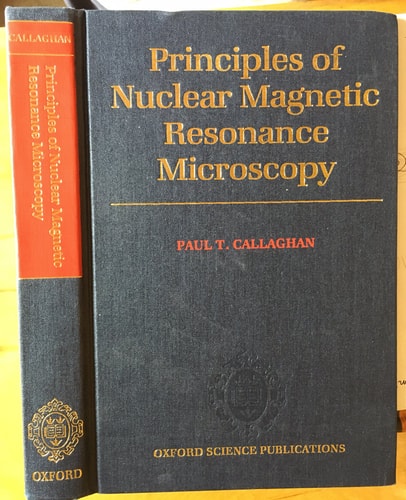
Principles of Nuclear Magnetic Resonance Microscopy
0
0
As an Amazon Associate and affiliate partner, Menrva Books earns from qualifying purchases. Learn more
Author Description
Nuclear magnetic resonance is best known for its spectacular utility in medical tomography. However, the method has potential applications in biology, materials science, and chemical physics, some of which are now being realized as laboratory NMR spectrometers are adapted to enable small scale imaging. NMR microscopy has available a rich variety of contrast including molecular specificity and sensitivity to molecular dynamics. In NMR imaging, the signal is acquired in k-space, a dimension which bears a Fourier relationship with the positions of nuclear spins. A dynamic analogue of k-space imaging is the Pulsed Gradient Spin Echo (PGSE) experiment in which the signal is acquired in q-space, conjugate to the distances moved by the spins over a well-defined time interval. Q-space microscopy provides images of the nuclear self-correlation function with a resolution some two orders of magnitude better than is possible in imaging the nuclear density. As well as revealing the spectrum of molecular motion, PGSE NMR can be used to study morphology in porous systems through the influence of motional boundaries. This book explores principles and common themes underlying these two variants of NMR Microscopy, providing many examples of their use. The methods discussed here are of importance in fundamental biological and physical research, as well as having applications in a wide variety of industries, including those concerned with petrochemicals, polymers, biotechnology, food processing, and natural product processing.
Menrva's Summary
THE THESIS
This text investigates the fundamental principles and practical applications of nuclear magnetic resonance (NMR) microscopy, focusing on its utility beyond medical imaging. Paul T. Callaghan, a distinguished researcher in the field, synthesizes the theoretical framework of k-space imaging with the dynamic capabilities of q-space microscopy. The book argues that by adapting laboratory NMR spectrometers, researchers can achieve high-resolution imaging of molecular dynamics and morphology in complex systems. It serves as a technical bridge between the physics of nuclear spins and the applied needs of industries such as biotechnology and materials science.
THE SCOPE MAP
What You Will Find
- Theoretical foundations of k-space and q-space imaging methodologies.
- Technical analysis of Pulsed Gradient Spin Echo (PGSE) experiments.
- Examination of molecular motion spectra and nuclear self-correlation functions.
- Case studies across diverse fields including petrochemicals, polymers, and food processing.
THE AUTHORITY PERSPECTIVE
Experts recognize this work as a foundational text for understanding the transition of NMR from clinical tomography to small-scale microscopy. Readers frequently note the high level of technical density, making it a primary resource for researchers and graduate students in chemical physics and materials science.
Page Count:
516
Publication Date:
1991-12-26
Publisher:
Oxford University Press
ISBN-10:
0198539444
ISBN-13:
9780198539445
Science
Biophysics
Chemistry
Nuclear Magnetic Resonance
Microscopy
Physics
Materials Science