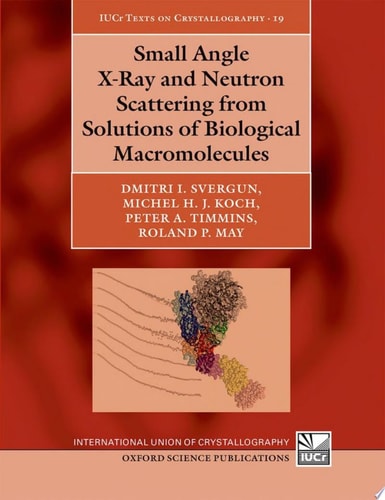
Small Angle X-Ray and Neutron Scattering from Solutions of Biological Macromolecules
0
0
As an Amazon Associate and affiliate partner, Menrva Books earns from qualifying purchases. Learn more
Author Description
Small-angle scattering of X-rays (SAXS) and neutrons (SANS) is an established method for the structural characterization of biological objects in a broad size range from individual macromolecules (proteins, nucleic acids, lipids) to large macromolecular complexes. SAXS/SANS is complementary to the high resolution methods of X-ray crystallography and nuclear magnetic resonance, allowing for hybrid modeling and also accounting for available biophysical and biochemical data. Quantitative characterization of flexible macromolecular systems and mixtures has recently become possible. SAXS/SANS measurements can be easily performed in different conditions by adding ligands or binding partners, and by changing physical and/or chemical characteristics of the solvent to provide information on the structural responses. The technique provides kinetic information about processes like folding and assembly and also allows one to analyze macromolecular interactions.The major factors promoting the increasingly active use of SAXS/SANS are modern high brilliance X-ray and neutron sources, novel data analysis methods, and automation of the experiment, data processing and interpretation.In this book, following the presentation of the basics of scattering from isotropic macromolecular solutions, modern instrumentation, experimental practice and advanced analysis techniques are explained. Advantages of X-rays (rapid data collection, small sample volumes) and of neutrons (contrast variation by hydrogen/deuterium exchange) are specifically highlighted. Examples of applications of the technique to different macromolecular systems are considered with specific emphasis on the synergistic use of SAXS/SANS with other structural, biophysical and computational techniques.
Menrva's Summary
THE THESIS
How can small-angle scattering of X-rays and neutrons be effectively utilized to determine the structural characteristics of biological macromolecules in solution? The authors, all experts in structural biology and scattering techniques, provide a comprehensive framework for applying SAXS and SANS to complex biological systems. They synthesize the physical principles of scattering with modern experimental practices to demonstrate how these methods complement high-resolution techniques like X-ray crystallography and NMR. The text serves as a technical guide for integrating scattering data into broader biophysical and computational models.
THE SCOPE MAP
What You Will Find
- Fundamental principles of scattering from isotropic macromolecular solutions.
- Modern instrumentation and experimental practices for SAXS and SANS.
- Advanced data analysis techniques for flexible systems and macromolecular mixtures.
- Comparative advantages of X-ray versus neutron sources, including contrast variation methods.
- Case studies demonstrating the synergistic use of scattering with other structural biology techniques.
THE AUTHORITY PERSPECTIVE
Experts in the field recognize this work as a foundational text for researchers utilizing scattering methods in structural biology. Readers frequently note the technical density of the prose, which is tailored for advanced students and practitioners in biophysics and crystallography.
Page Count:
368
Publication Date:
2013-11-01
Publisher:
Oxford University Press
ISBN-10:
0199639531
ISBN-13:
9780199639533
Science
Biology
Biophysics
Chemistry
Reference
Physics
X-rays
Community Tags
Other Editions(2)

Similar Books














Reader Comments
Share Your Thoughts
No comments yet. Be the first to share your thoughts!