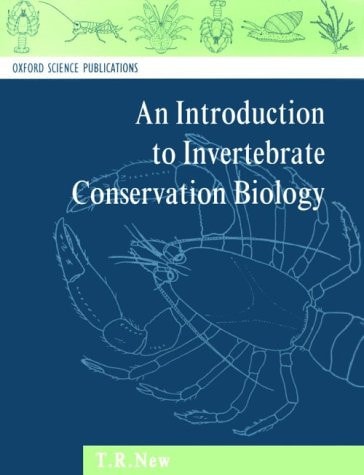
Introduction to Invertebrate Conservation Biology
0
0
As an Amazon Associate and affiliate partner, Menrva Books earns from qualifying purchases. Learn more
Author Description
Invertebrates are far and away the most diverse and abundant animals in most natural ecosystems, yet their importance in sustaining those systems is commonly not appreciated, nor are their needs adequately taken into account in the assessment and planning of conservation priorities. Until now there has been no current textbook providing the much-needed information on conservation of sponges, earthworms, molluscs, crustaceans, and insects to counterbalance knowledge of birds, mammals, and fish. This is the first book to give a global view of the conservation biology of the invertebrates in their major habitats - terrestrial, freshwater, and marine. Discussion of the importance of invertebrates and the rationale for their conservation, and of priorities in the field, is followed by an appraisal of threatening processes and practical approaches to conserving invertebrates. A chapter on captive breeding and introductions is followed by discussion of species protection and status assessment, and the book concludes with selected case-histories and suggestions for a practical agenda. Sections on 'Further Reading' at chapter ends and a comprehensive bibliography provide the reader with a directed entry to the literature.
Menrva's Summary
THE THESIS
This text addresses the critical oversight of invertebrate species in global conservation planning by providing a comprehensive framework for their protection and ecological management. T. R. New, a specialist in entomology and conservation, synthesizes existing ecological data to argue that invertebrates are fundamental to ecosystem stability. The book establishes a structured approach for assessing the status of diverse invertebrate groups, including molluscs, crustaceans, and insects, across terrestrial, freshwater, and marine environments.
THE SCOPE MAP
What You Will Find
- Global analysis of invertebrate conservation across terrestrial, freshwater, and marine habitats.
- Methodologies for species status assessment and the evaluation of threatening processes.
- Practical approaches to habitat management, captive breeding, and reintroduction programs.
- Case histories illustrating successful and failed conservation interventions.
THE AUTHORITY PERSPECTIVE
Experts recognize this work as a foundational textbook that successfully bridges the gap between vertebrate-centric conservation models and the neglected needs of invertebrate populations. Readers frequently note the academic rigor and the utility of the extensive bibliographies for students and professionals in the field of conservation biology.
Page Count:
208
Publication Date:
1995-10-05
Publisher:
Oxford University Press
ISBN-10:
0198540523
ISBN-13:
9780198540526
Science
Zoology
Wildlife conservation
Ecology
Conservation
Invertebrates
Biology