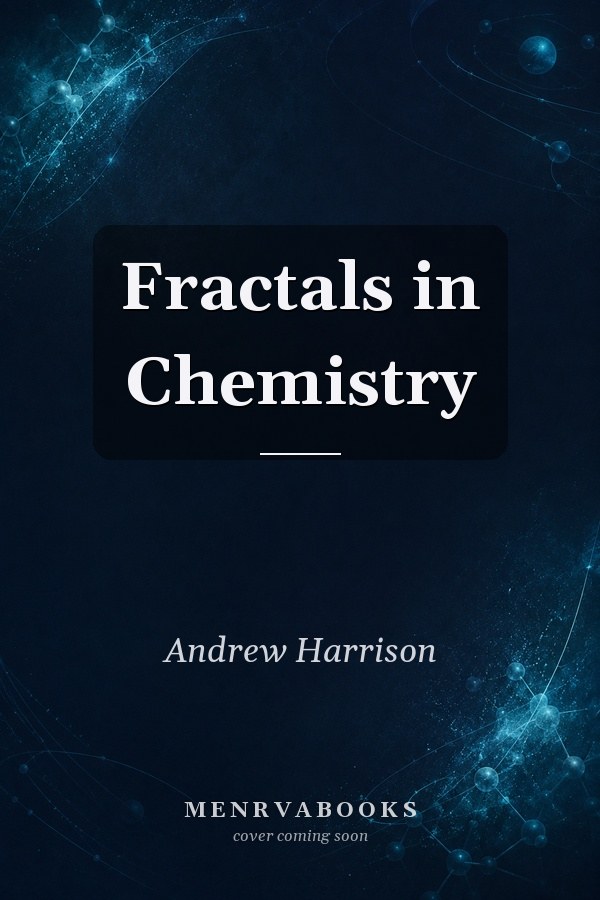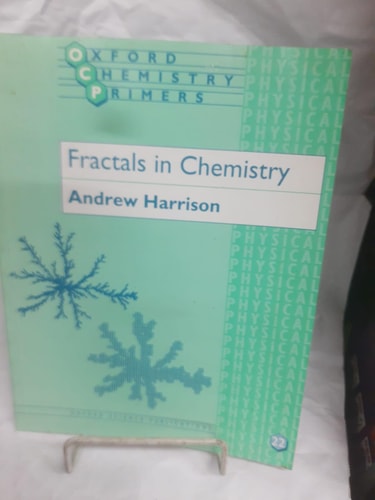
Fractals in Chemistry
0
0
As an Amazon Associate and affiliate partner, Menrva Books earns from qualifying purchases. Learn more
Author Description
The patterns of frost on a cold window, eroded landscapes, and particles grown in an aerosol all have forms that are conventionally regarded as irregular, with little or no symmetry. In Fractals in Chemistry, the reader is introduced to the fractal dimension, a concept that allows for a unified description of such diverse and irregular objects, and implies that they all possess heretofore unperceived symmetries. The text explains how the growth of such objects is controlled by similar, simple processes, and how modest experiments bring to life the principles involved. Topics include fractal forms, fractal growth, characterizing fractals, and chemistry in fractal environments. Throughout, the text emphasizes the relevance of fractal concepts to the structure and chemistry of porous solids and to the growth of polymers and colloids in liquid and gaseous phases. Concise and easy-to-read, this book is ideal for students and researchers in chemistry, physics, and materials science.
Menrva's Summary
THE THESIS
This book investigates how the mathematical concept of fractal dimension provides a unified framework for describing irregular structures and growth processes within chemical systems. Author Andrew Harrison, a specialist in the field, utilizes this primer to bridge the gap between abstract geometry and practical chemical applications. By examining how simple growth processes govern complex, irregular forms, the text argues that seemingly chaotic structures in nature and laboratory settings actually follow predictable, symmetrical patterns. The work serves as an introductory guide for students and researchers to apply these principles to porous solids, polymers, and colloids.
THE SCOPE MAP
What You Will Find
- Mathematical definitions and applications of fractal dimension in chemical contexts.
- Analysis of growth mechanisms for irregular objects in liquid and gaseous phases.
- Experimental methodologies for characterizing fractal structures in materials science.
- Theoretical exploration of chemistry occurring within fractal environments, including porous solids.
THE AUTHORITY PERSPECTIVE
Experts and students frequently identify this text as a concise and accessible entry point for understanding the intersection of geometry and physical chemistry. Readers often note that the prose maintains a high level of clarity, making complex mathematical concepts manageable for those in the chemical and materials sciences.
Page Count:
96
Publication Date:
1995-06-29
Publisher:
Oxford University Press
ISBN-10:
0198557671
ISBN-13:
9780198557678
Fractals
Academic
Physics
Chemistry