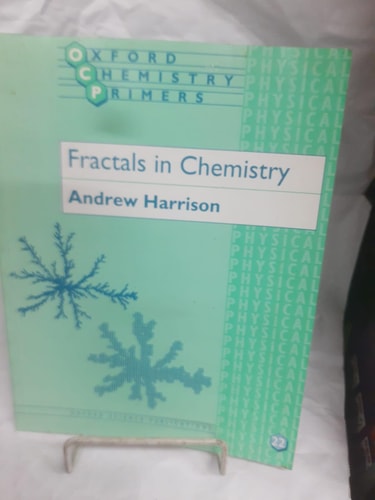
Fractals in Chemistry
0
0
As an Amazon Associate and affiliate partner, Menrva Books earns from qualifying purchases. Learn more
Author Description
The patterns of frost on a cold window, eroded landscapes, and particles grown in an aerosol all have forms that are conventionally regarded as irregular, with little or no symmetry. In Fractals in Chemistry, the reader is introduced to the fractal dimension, a concept that allows for a unified description of such diverse and irregular objects, and implies that they all possess heretofore unperceived symmetries. The text explains how the growth of such objects is controlled by similar, simple processes, and how modest experiments bring to life the principles involved. Topics include fractal forms, fractal growth, characterizing fractals, and chemistry in fractal environments. Throughout, the text emphasizes the relevance of fractal concepts to the structure and chemistry of porous solids and to the growth of polymers and colloids in liquid and gaseous phases. Concise and easy-to-read, this book is ideal for students and researchers in chemistry, physics, and materials science.
Menrva's Summary
THE THESIS
This book investigates how the concept of fractal dimension provides a unified mathematical and physical framework for describing irregular structures in chemical systems. Author Andrew Harrison, drawing on his expertise in chemistry and materials science, argues that seemingly chaotic patterns in nature—such as frost, eroded landscapes, and aerosol particles—are governed by simple, repeatable growth processes. The text synthesizes these observations to demonstrate that fractal geometry is a practical tool for understanding the structure and reactivity of complex materials.
THE SCOPE MAP
What You Will Find
- Mathematical definition and application of fractal dimension in chemical systems
- Analysis of growth processes for polymers, colloids, and porous solids
- Experimental methodologies for characterizing fractal structures in liquid and gaseous phases
- Theoretical exploration of chemistry occurring within fractal environments
THE AUTHORITY PERSPECTIVE
Experts and students frequently cite this primer as a clear, accessible entry point into the application of fractal geometry within the physical sciences. The text is noted for its ability to distill complex mathematical concepts into practical applications for researchers in chemistry and materials science.
Page Count:
96
Publication Date:
2099-11-30
Publisher:
Oxford University Press
ISBN-10:
019855768X
ISBN-13:
9780198557685
Science
Physics
Fractals
Chemistry