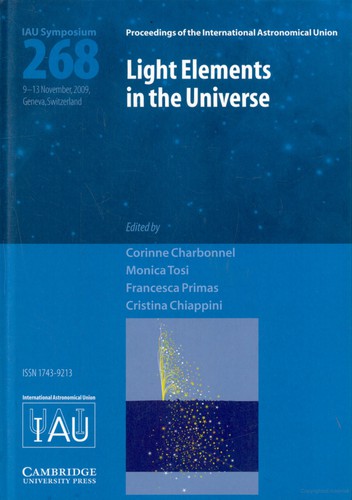
Light elements in the universe
0
0
As an Amazon Associate and affiliate partner, Menrva Books earns from qualifying purchases. Learn more
Author Description
IAU Symposium 268 presents an overview of the most recent observational and theoretical research on the formation and evolution of light elements in the Universe: H, He, Li, Be, B, and their isotopes. Astrophysicists from a variety of subfields discuss recent developments that will improve our understanding of the light elements and provide important clues to stellar and galactic evolution, Big Bang nucleosynthesis, and cosmology. Striking observational progress has been achieved recently through the advent of next generation ground- and space-based telescopes, such as the cosmic microwave background experiments that allow the accurate determination of the baryon density of the Universe. New theoretical breakthroughs in describing stellar interiors and the chemical evolution of complex systems and the remaining challenges in this field are also addressed. This critical review is a useful resource for all those interested in the chemical evolution of the Universe.
Menrva's Summary
THE THESIS
This symposium explores the formation and evolution of light elements in the universe, focusing on hydrogen, helium, lithium, beryllium, and boron. Astrophysicists present recent observational and theoretical research, utilizing advancements in ground- and space-based telescopes, including cosmic microwave background experiments, to accurately determine the universe's baryon density. The work also addresses new theoretical breakthroughs in stellar interiors and chemical evolution, highlighting remaining challenges in the field.
THE SCOPE MAP
- Overview of recent observational and theoretical research on light element formation and evolution.
- Discussion of H, He, Li, Be, B, and their isotopes.
- Impact of next-generation ground
- and space-based telescopes on observational progress.
- Accurate determination of the baryon density of the Universe via cosmic microwave background experiments.
- New theoretical breakthroughs in describing stellar interiors.
- Analysis of the chemical evolution of complex systems.
- Identification of remaining challenges in the field of light element research.
- Resource for understanding the chemical evolution of the Universe.
THE AUTHORITY PERSPECTIVE
IAU Symposium 268 is presented as a critical review and a useful resource for those interested in the chemical evolution of the Universe. The symposium brings together astrophysicists from various subfields to discuss recent developments that promise to enhance understanding of light elements. These discussions are expected to provide important clues for stellar and galactic evolution, Big Bang nucleosynthesis, and cosmology. The compilation reflects striking observational progress and new theoretical breakthroughs.
Page Count:
504
Publication Date:
2010-01-01
ISBN-10:
0521765064
ISBN-13:
9780521765060
Non-Fiction
Science
Cosmology
Astronomy
Astrophysics
Community Tags
Similar Books