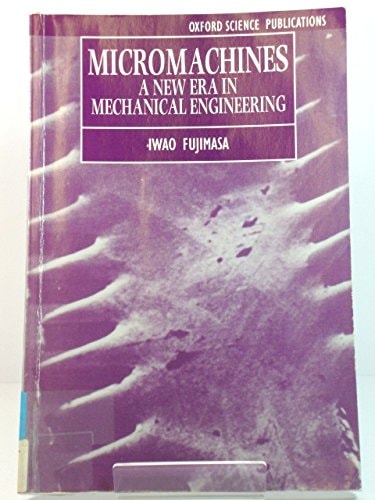
Micromachines: A New Era in Mechanical Engineering
0
0
As an Amazon Associate and affiliate partner, Menrva Books earns from qualifying purchases. Learn more
Author Description
Micromachine technology and development is very recent in the long history of mechanical engineering, and as new microscopes make the miniature realms of micromechanisms accessible, it is at this tiny scale that the biggest opportunities and challenges are to be found. Fujimasa, a leading Japanese researcher in this field, examines the brief history of micromachines and the technologies that make their fabrication possible. By taking biological structures (and cells in particular) as good models of micromachines, he has been able to develop a successful series of new applications along with their basic working principles.
Menrva's Summary
THE THESIS
This text investigates the emergence of micromachine technology and the potential for biological systems to serve as blueprints for future mechanical engineering advancements. Iwao Fujimasa, a prominent researcher in the field, utilizes his expertise to bridge the gap between biological observation and mechanical fabrication. The book presents a framework for understanding how miniature realms can be harnessed to solve complex engineering challenges through the study of cellular structures and their inherent functional principles.
THE SCOPE MAP
What You Will Find
- A historical overview of the development of micromachine technology.
- Analysis of fabrication techniques for miniature mechanical systems.
- Biological models, specifically cellular structures, as templates for engineering design.
- Theoretical and practical applications of micromechanisms in modern engineering.
THE AUTHORITY PERSPECTIVE
Experts recognize this work as a foundational text that effectively links biological observation with mechanical engineering principles. Readers frequently note the technical clarity of the prose, which makes complex fabrication concepts accessible to those entering the field of micro-scale engineering.
Page Count:
156
Publication Date:
1996-12-19
Publisher:
Oxford University Press
ISBN-10:
0198565283
ISBN-13:
9780198565284
Science
Nanotechnology
Technology
Engineering
Biomimetics